Master of Arts (MA) in International Healthcare Management
This comprehensive training seminar prepares participants to manage and oversee business operations effectively.
Request follow-up
Fill in the form below and one of our student advisers will contact you soon.
Duration
12 Months
Pedagogy
Blended
Instalment
DZD 48,043 /month interest-free*
Total tuition
DZD 640,577
About the course
This comprehensive training seminar empowers participants to manage the flow of commodities in business. This includes overseeing the transportation and storage of raw materials, maintaining inventories of items in various stages of production, and ensuring the smooth movement of finished products from production to consumption.Learners will gain the ability to add value to business operations, establish a competitive infrastructure, harness the advantages of global logistics, balance supply and demand effectively, and monitor international performance. The supply chain encompasses the field of logistics, which encompasses the storage and delivery of products and services in the right quantity, quality, timing, and location. This course offers an advanced overview of supply chain functions and facilitates a comprehensive understanding of related concepts and actions.
The course utilizes a variety of learning tools, including individual exercises, group discussions, case studies, and instructional videos.
Course details
About the Special Executive Masters ProgrammeThe Special Executive Masters Programme is a brief certificate training/seminar tailored for individuals seeking a deeper understanding of business concepts within a condensed timeframe. This program caters to accomplished professionals or experts in various sectors, including private, public, and non-profit, who have assumed new managerial roles and require a rapid expansion of their management expertise.
The (SEMP) Programme serves as a refresher course for those who obtained their Master's Degree some time ago and need a quick review. It also serves as an academic update for highly experienced professionals who never had the opportunity to pursue a master's degree but require the academic and practical insights it offers. Newly promoted individuals to managerial positions find this program invaluable as it aids in their transition and decision-making process.
Objectives
Upon completion of this course, participants will be able to:
1. Apply forecasting and stock management techniques.
2. Evaluate item categories and formulate suitable sourcing strategies.
3. Explain the role and objectives of transportation in logistics.
4. Utilize value-adding warehousing strategies.
5. Identify trends and contemporary practices in logistics and supply chain management.
6. Manage supply chain performance through the application of the Supply Chain Operations Reference.
Who should attend?
Professionals in the field of supply chain and logistics, operational managers, and individuals in supervisory roles will benefit from this program. Additionally, learners seeking to enhance their knowledge of logistics and supply chain practices with the latest techniques are encouraged to participate.
Modules:
Day 1: Current Developments In Supply Chains And Logistics:
- Overview of supply chain management.
- Understanding the role of logistics in business development.
- Addressing sustainability in logistics and supply chain management.
- Establishing a functional supply chain system.
- Concepts of Third-Party Logistics and Fourth-Party Logistics.
Day 2: Planning For Inventory And Materials Forecasting:
- Exploring Qualitative and Quantitative forecasting theories.
- Familiarizing with the Delphi technique in supply chain management.
- Grasping the concepts of seasonal and non-seasonal demand forecasting in logistics management.
- Utilizing various statistical methods in supply chain management, including Moving average, Weighted moving average, Exponential smoothing, Forecasting error, and economic order quantities.
- Implementing reorder points and replenishment strategies in logistic management.
Day 3: Procurement And Transportation Strategies:
- Understanding the procurement process and its flow.
- Exploring outsourcing techniques and vendor management.
- Defining transportation modalities, optimizing routing, and cubing.
- Gaining insights into fleet management, its objectives, and disadvantages.
Day 4: Warehousing Handling In Logistics Management:
- Examining essential warehouse network architecture, warehousing space configuration, and value-added activities.
- Establishing storage, assortments, and spot stocking.
- Dealing with consolidation, break bulking, and cross-docking.
- Managing mixing, delaying, and custom assembly.
- Handling tools and equipment in the logistics context.
- Understanding logistics in reverse.
Day 5: Supply Chain Operations Reference (SCOR) Framework For Performance Management:
- Overview of the SCOR framework.
- Exploring level 1, level 2, and level 3 SCOR metrics.
- Customized level 4 SCOR measurements.
- Setting performance goals and continuous performance improvement.
- Analyzing supply chain management case studies.
Accreditation
All of our courses are accredited by the relevant partners and awarding bodies. Please refer to our information in about us for more details.Entry requirement
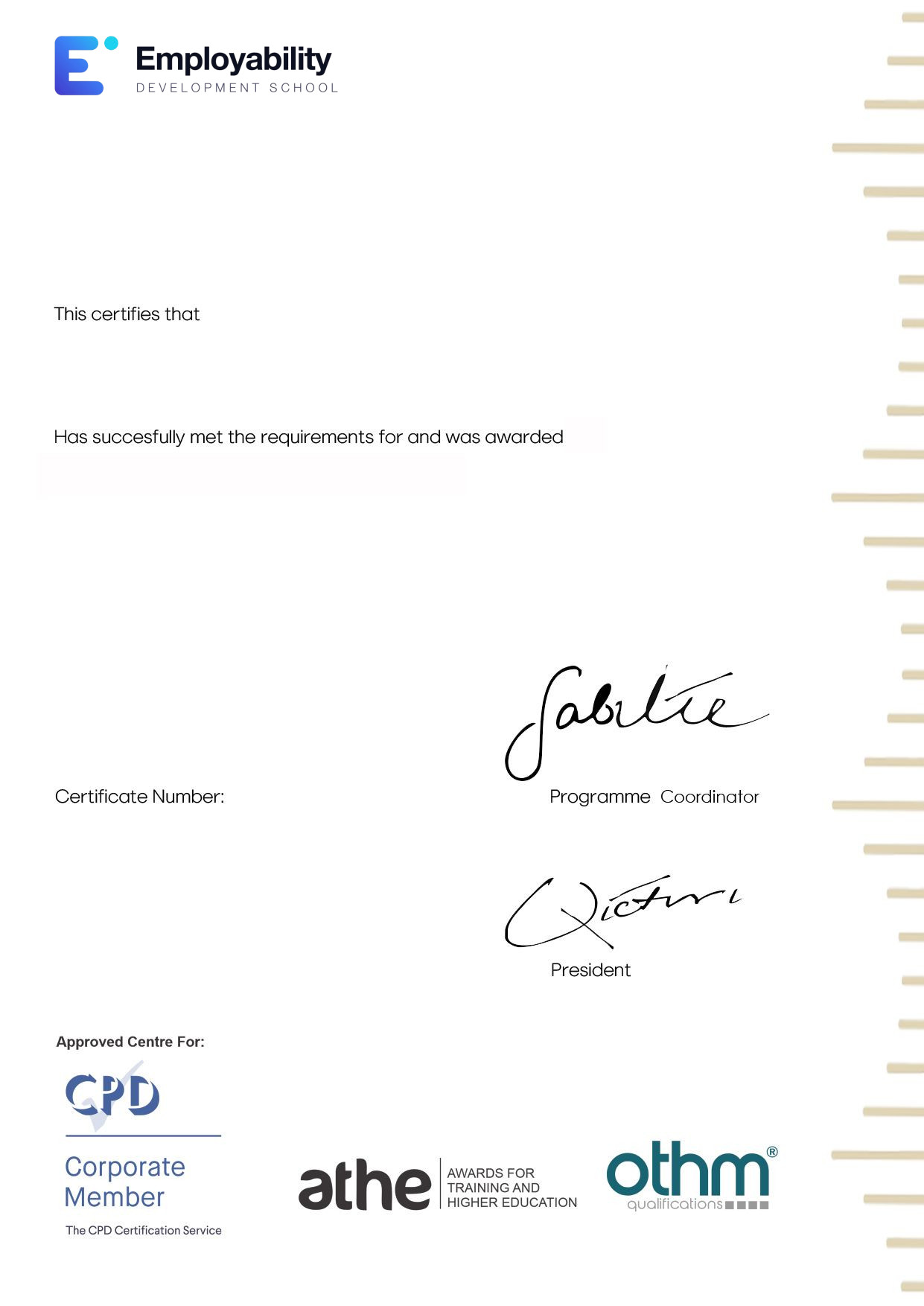
The Programme does not have stringent academic prerequisites since it is a Non-Credit Bearing Programme. Nevertheless, individuals pursuing this program should possess practical experience in roles such as Team Lead, Supervisor, or Manager.Sample Certificate
What you'll learn
Module 1
ADVANCED RESEARCH METHODS
This module covers key elements that are essential for understanding the course material.
Module 2
GLOBAL HEALTHCARE MARKETS
This module covers key elements that are essential for understanding the course material.
Module 3
HEALTH ECONOMICS
This module covers key elements that are essential for understanding the course material.
Module 4
HEALTHCARE FINANCING
This module covers key elements that are essential for understanding the course material.
Module 5
INTERNATIONAL HEALTH SYSTEMS
This module covers key elements that are essential for understanding the course material.
Module 6
MANAGING PEOPLE AND ORGANIZATION
This module covers key elements that are essential for understanding the course material.
How learners like you are achieving their goals
Participants in our courses don’t just learn new skills, they enjoy the experience too.

Zainab P.
EgyptExecutive Education
A smart way to enhance my knowledge within a short period of time, the course is very productive and beneficial for me...so grateful that i completed successfully...i would recommend my friends and family about the course.

Andrew S.
United StatesExecutive Education
Truly enjoyed the Strategic Management and Leadership Level 7 course and it provided me with a clear insight and helped me in my daily work as Plant Manager.

Richard T.
ScotlandExecutive Education
The modules were well structured, and gave me the knowledge to make sound decisions that maximize performance.

Rachel O.
NigeriaExecutive Education
I have learned a lot and gain experienced in this course. At first, I did not have confidence when standing front of audience but now, it is a different story.
Other related courses
MBA - E-Sports Management
The Advanced Professional Certificate in Strategic Marketing Management aims to provide learners with the necessary knowledge and practical skills for conducting marketing activities and operations in the context of our increasingly globalized world.
-
Access to this course.
-
Access to library.
-
Learn at your own pace.
-
Tests to boost your learning.
-
Digital certificate when eligible.

Course starts
Anytime
Completion time
18 Months
Limited time offer
DZD 1,079,830
DZD 1,943,694
Master of Arts (MA) in Marketing Management
The Advanced Professional Certificate in Strategic Human Resource Management aims to empower learners with the knowledge and skills needed to comprehend both the theory and practical aspects of effectively managing human resources within any organization. This entails ensuring that the management of critical talent is geared towards strategically aligning with the organization's objectives through their development, motivation, and retention.
-
Access to this course.
-
Access to library.
-
Learn at your own pace.
-
Tests to boost your learning.
-
Digital certificate when eligible.

Course starts
Anytime
Completion time
12 Months
Limited time offer
DZD 640,577
DZD 1,153,039
Executive Master of Business Administration (EMBA) in Health Care Management
The programme offers a practical understanding of healthcare management and leadership.
-
Access to this course.
-
Access to library.
-
Learn at your own pace.
-
Tests to boost your learning.
-
Digital certificate when eligible.

Course starts
Anytime
Completion time
12 Months
Limited time offer
DZD 915,110
DZD 1,647,198
Master of Arts (MA) in Digital Marketing
This comprehensive training seminar intends to equip the participant with the awareness that they bear the responsibility for their enterprise, and their choices have the potential to either enhance or jeopardize it.
-
Access to this course.
-
Access to library.
-
Learn at your own pace.
-
Tests to boost your learning.
-
Digital certificate when eligible.

Course starts
Anytime
Completion time
12 Months
Limited time offer
DZD 640,577
DZD 1,153,039