MBA - Engineering Management
The Advanced Professional Certificate program in System Analysis and Design is designed to acquaint the learner with the principles of system analysis and design, incorporating advanced project management techniques. This knowledge is crucial for effectively conceiving, developing, and implementing organizational systems.
Request follow-up
Fill in the form below and one of our student advisers will contact you soon.
Duration
18 Months
Pedagogy
Blended
Instalment
DZD 80,987 /month interest-free*
Total tuition
DZD 1,079,830
About the course
The Advanced Professional Certificate in System Analysis and Design aims to introduce learners to the concepts of system analysis and design, along with advanced knowledge of project management to ensure the successful design, development, and implementation of organizational systems.Learners will gain the ability to comprehend and create essential diagrams for designing new organizational systems. They will also integrate socio-technical aspects to understand both the technical and human requirements involved in system development and implementation.
**Learning Outcomes**
Upon completing the certificate successfully, students will acquire the following skills:
1. Explain project planning, scheduling, monitoring, and reporting.
2. Describe work breakdown structures, task patterns, and critical path analysis.
3. Discuss techniques for estimating task completion times and costs.
4. Describe various scheduling tools, such as Gantt charts and PERT/CPM charts.
5. Analyze task dependencies, durations, start dates, and end dates.
6. Understand the significance of systems analysis and design in information systems design.
7. Describe the purpose of the system development life cycle (SDLC).
8. Explain the six core processes that constitute the SDLC.
9. Elaborate on Agile methodologies.
10. Describe iterative system development.
11. Identify key documents used in project planning.
12. Recognize key diagrams employed in systems analysis and design.
13. Explore the factors contributing to success and failure in IT systems.
14. Understand the socio-technical nature of IT systems, encompassing hardware, software, organizational, social, and human components.
15. Consider the legal, social, ethical, and professional contexts in which IT systems are acquired, developed, and deployed.
Course details
In engineering, qualified specialists and managers are in high demand! During your MBA - Engineering Management online study programme, you’ll combine technical production expertise with management skills. If you already have professional experience in this field, completing our online MBA specialising in Engineering Management will take your career to the next level.
Over the course of your studies, you'll expand your management skills and learn how to lead teams to success as an Engineering Project Manager. You'll also deal with budgeting and cost planning, as well as evaluating quality standards. This will prepare you perfectly to work wherever interdisciplinary expertise in management and technology is called for.
After graduating from our MBA Engineering Management programme, you’ll be a sought-after expert at the interface between technology and management.
Accreditation
All of our courses are accredited by the relevant partners and awarding bodies. Please refer to our information in about us for more details.Entry requirement
Entry requirements for this course are flexible, with no stringent prerequisites. Possessing work experience can provide an additional advantage in comprehending the course content.The certificate program is crafted to enrich the learner's understanding within their chosen field. It caters to individuals who are enthusiastic about expanding their knowledge and staying up-to-date with the latest ideas in their respective domains. This certificate is highly recommended for the following professionals:
1. Chief Executive Officers
2. Directors
3. Managers
4. Supervisors
5. IT Managers
6. System Developers
7. System Consultants
8. Project Managers
9. Project Engineers
10. System Administrators
11. Project Supervisors
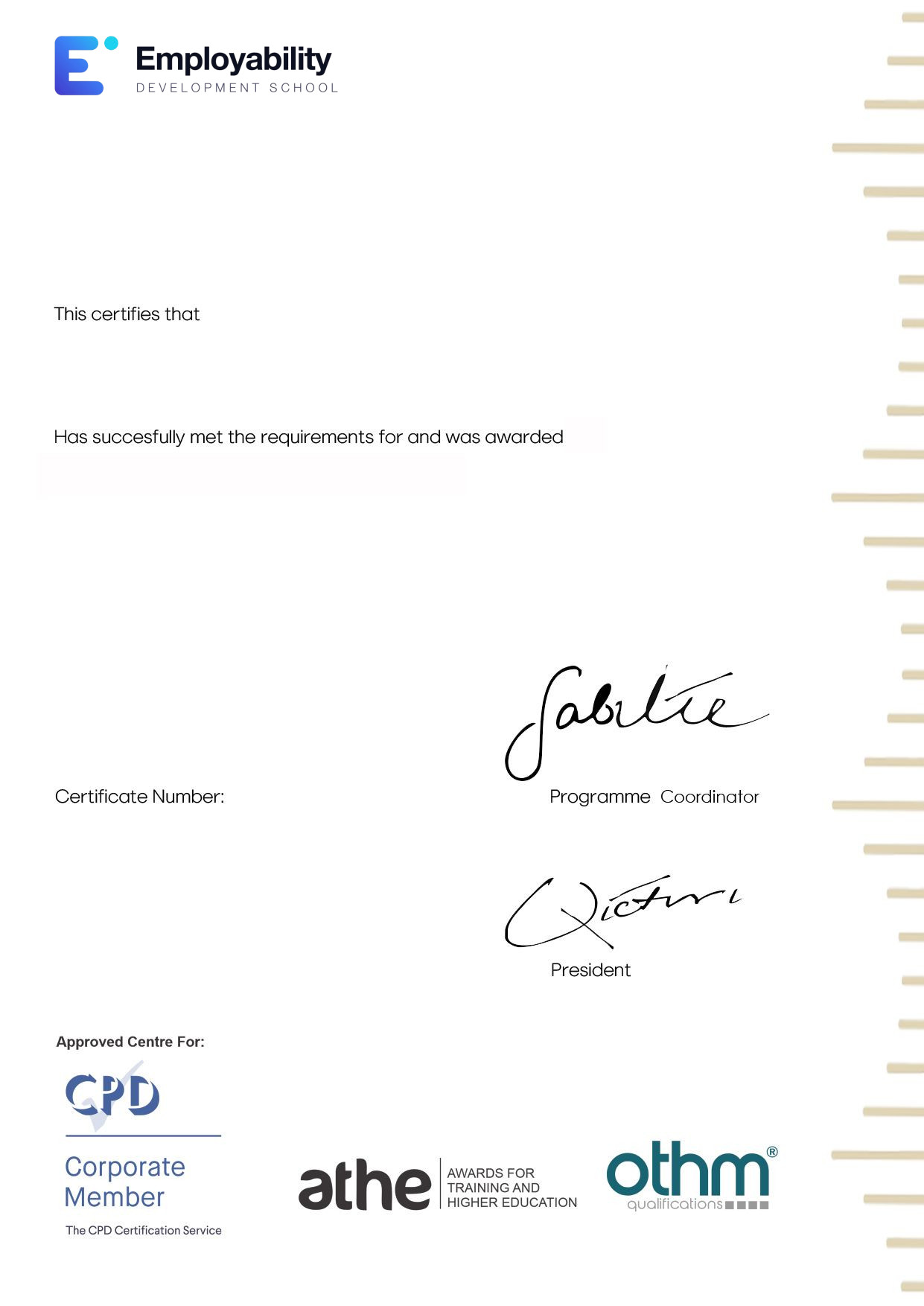
Sample Certificate
What you'll learn
Module 1
ASSIGNMENT & STUDY GUIDELINES
This module provides the most critical information about the study course and assignment submission.
Module 2
Leadership
In contemporary society, personnel stands as a firm's most prized resource. A fundamental duty of leadership involves elevating the wisdom, proficiencies, and capabilities of the workforce. Proficient leadership is indispensable for a corporation's enduring triumph amid escalating market rivalry. This course imparts proficiency in contemporary, knowledge-centric organizational leadership by addressing key inquiries in leadership theory and its real-world implementation, with a focus on strategic management and transformative procedures.
Module 3
Innovation And Entrepreneurship
Innovation and Entrepreneurship courses strive to impart to students the foundational principles, methodologies, and a mindset conducive to crafting fresh enterprises and introducing novel concepts to the marketplace. The objective is to equip students with the ability to discern and assess prospects within the realm of new business endeavors, and to formulate a comprehensive strategy for their successful realization.
Module 4
International Marketing
Global marketing seeks to foster a thorough grasp of the global business landscape and the methods and maneuvers employed for the prosperous vending of goods and services in a worldwide arena. This encompasses comprehension of cultural and economic distinctions, scrutiny of worldwide market trends and prospects, formulation of potent marketing mix strategies, and alignment with diverse legal and regulatory paradigms. It further empowers enterprises to pinpoint fresh markets and customer segments and to cultivate and sustain fruitful associations with international collaborators and stakeholders.
Module 5
Managerial Economics
This module has been designed to offer insight into fundamental principles and concepts within micro and macroeconomic theory, along with their practical applications in the realm of management. It equips individuals with the economic analysis tools and techniques frequently employed in managerial decision-making. Additionally, it fosters the capacity to assess and address economic challenges encountered by businesses and organizations.
Module 6
Performance Measurement
The module focusing on performance measurement is designed to equip learners with the necessary knowledge and skills for comprehending and implementing performance measurement systems within organizations. This encompasses grasping various performance measures and metrics, recognizing pivotal performance indicators, choosing suitable measures and metrics, and crafting proficient performance measurement systems.
Module 7
Corporate Finance
Corporate Finance aims to t
How learners like you are achieving their goals
Participants in our courses don’t just learn new skills, they enjoy the experience too.

Zainab P.
EgyptExecutive Education
A smart way to enhance my knowledge within a short period of time, the course is very productive and beneficial for me...so grateful that i completed successfully...i would recommend my friends and family about the course.

Andrew S.
United StatesExecutive Education
Truly enjoyed the Strategic Management and Leadership Level 7 course and it provided me with a clear insight and helped me in my daily work as Plant Manager.

Richard T.
ScotlandExecutive Education
The modules were well structured, and gave me the knowledge to make sound decisions that maximize performance.

Rachel O.
NigeriaExecutive Education
I have learned a lot and gain experienced in this course. At first, I did not have confidence when standing front of audience but now, it is a different story.
Other related courses
MSc in Project Management
The objective of the Professional Certificate in Monitoring and Controlling Projects is to provide learners with the necessary tools for effectively managing projects, ensuring they adhere to their defined scope and minimizing any potential deviations caused by project changes.
-
Access to this course.
-
Access to library.
-
Learn at your own pace.
-
Tests to boost your learning.
-
Digital certificate when eligible.

Course starts
Anytime
Completion time
12 Months
Limited time offer
DZD 1,098,132
DZD 1,976,638
Executive Master of Business Administration (EMBA) in Social Work
The programme is designed to offer skills and understanding in professional social work and in managing an effective community, family and individual social work.
-
Access to this course.
-
Access to library.
-
Learn at your own pace.
-
Tests to boost your learning.
-
Digital certificate when eligible.

Course starts
Anytime
Completion time
12 Months
Limited time offer
DZD 915,110
DZD 1,647,198
MBA - IT Management
The study of your online MBA – IT Management programme is decidedly practice-oriented. You’ll acquire all the relevant business skills you need for a successful career as an IT manager.
-
Access to this course.
-
Access to library.
-
Learn at your own pace.
-
Tests to boost your learning.
-
Digital certificate when eligible.

Course starts
Anytime
Completion time
18 Months
Limited time offer
DZD 1,079,830
DZD 1,943,694
MBA - Healthcare Management
The Advanced Professional Certificate in Business Administration aims to provide learners with an advanced understanding of business concepts and techniques for effective management of business operations. It also focuses on strategy development, knowledge management within organizations, and the analysis and preparation of financial statements.
-
Access to this course.
-
Access to library.
-
Learn at your own pace.
-
Tests to boost your learning.
-
Digital certificate when eligible.

Course starts
Anytime
Completion time
18 Months
Limited time offer
DZD 1,079,830
DZD 1,943,694