International Postgraduate Diploma In Economics
The IPGD in Economics Program offered provides a technical understanding of economics that includes various economics and management programs.
Request follow-up
Fill in the form below and one of our student advisers will contact you soon.
Duration
6 Months
Pedagogy
Blended
Instalment
BDT 52,260 /month interest-free*
Total tuition
BDT 195,976
About the course
The IPGD in Economics Program provides a technical understanding of economics that includes various economics and management programs. This program emphasizes the use of quantitative and statistical methods to make informed decisions, remodel economic systems, and analyze data. It is distinctive because it incorporates all relevant fields, including economic policy, finance, and industry perspectives. You will comprehensively understand advanced economic theories and develop skills relevant to modern business needs.
The program is designed to provide you with excellent intellectual returns. Through practical projects and seminars, you will engage in high-level discussions and group tasks that will prepare you for current industry requirements. Upon graduation, you will be qualified to pursue various careers, such as economic consulting, working for central banks, or joining reputable financial organizations based on your interests and professional objectives.
Course details
Assessment: Assignments
The overall objective of this economics course is to provide students with a comprehensive understanding of various economic theories and their practical applications in different fields.
This qualification reflects current practices in Economics. It Introduces the students to the fundamental concepts of micro and macroeconomics and help them develop analytical skills to understand the economic behavior of individuals, firms, and markets. It help to explore the principles of business economics, including supply and demand analysis, cost-benefit analysis, pricing strategies, and market structures, to help students understand the economic aspects of running a business.
Programme Structure and Credits:
This programme consists of 6 modules with a total of 120 credits.
Accreditation
All of our courses are accredited by the relevant partners and awarding bodies. Please refer to our information in about us for more details.
Entry requirement
A learner must fulfil at least one of the following criteria to be allowed entry to the qualification:
- Possession of an honours degree in a related subject that was taught in English or at least five years of proven managerial experience.
- Possession of a level 6 qualification from a recognized awarding body
- Five years of management experience
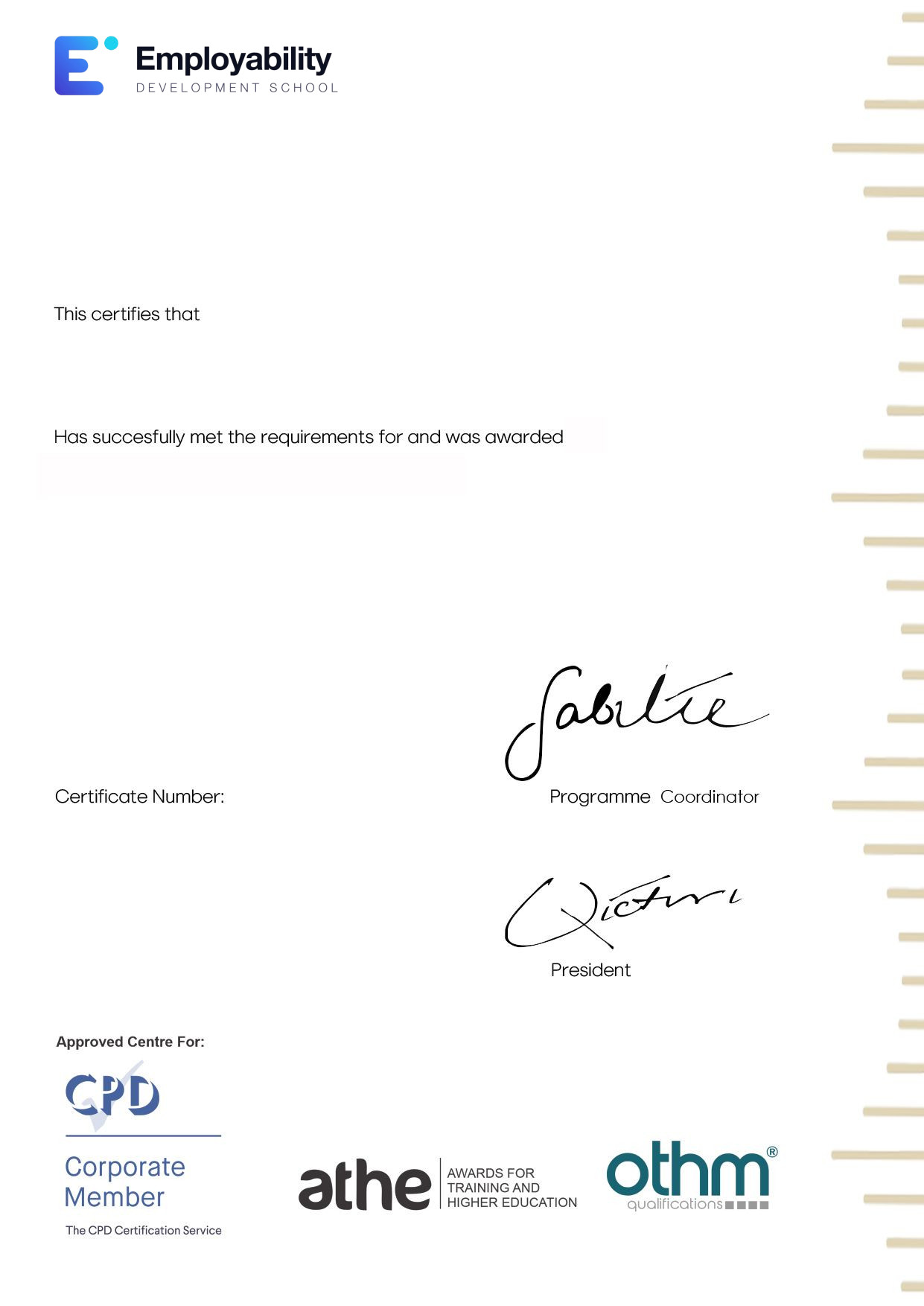
Sample Certificate
What you'll learn
Module 1
ASSIGNMENT & STUDY GUIDELINES
This module provides the most critical information about the study course and assignment submission.
Module 2
ECONOMICS IN HEALTHCARE
Healthcare economics is a field within economics that centers on the allocation, distribution, and utilization of resources within the healthcare sector. This field delves into the financing, delivery, and evaluation of healthcare services with the aim of enhancing the overall efficiency and effectiveness of the healthcare system.
Module 3
BUSINESS ECONOMICS
This module covers key elements that are essential for understanding the course material.
Module 4
GLOBAL BUSINESS ENTERPRISES
The Global Business Enterprises course encompasses a broad spectrum of topics, including the international business landscape, trade dynamics, investments, marketing strategies, and supply chain management. Throughout this course, students will cultivate proficiency in cross-cultural communication, gain insights into the legal and economic variables that influence business operations, and formulate effective approaches for entering and expanding in foreign markets.
Module 5
BUSINESS MANAGEMENT
The Business Management module offers students a holistic grasp of contemporary business management's fundamental principles and methodologies. This module encompasses an array of management facets, ranging from strategic planning and organizational structure to leadership, human resource oversight, financial administration, and operational management. It delves into the art of crafting and perpetuating a competitive edge in the business sphere through adept managerial strategies, equipping managers with the ability to make well-informed decisions in pursuit of corporate goals. Through the exploration of case studies and practical instances, students will cultivate the acumen and capabilities essential for effectively steering and spearheading prosperous enterprises within a dynamic and ever-evolving business landscape.
Module 6
SOCIO-ECONOMIC AND LEGAL FRAMEWORK
The Socio-Economics and Legal Framework course delves into the dynamic relationship among economic, social, and legal elements within modern societies. It assesses issues such as poverty, inequality, social equity, and human rights while investigating the regulatory role of legal structures in economic endeavors. By engaging in case studies, students cultivate their abilities for critical analysis and the development of well-informed solutions geared towards sustainable development.
Module 7
RESEARCH METHODS
The Research Methods module delves into research design, data collection, and analysis through diverse methodologies. It delves into ethical considerations and the application of technology. By engaging in hands-on activities, students hone their abilities in planning research, analyzing data, and composing reports. The module's objective is to furnish students with the necessary knowledge and expertise to autonomously undertake and assess research.
How learners like you are achieving their goals
Participants in our courses don’t just learn new skills, they enjoy the experience too.

Zainab P.
EgyptExecutive Education
A smart way to enhance my knowledge within a short period of time, the course is very productive and beneficial for me...so grateful that i completed successfully...i would recommend my friends and family about the course.

Andrew S.
United StatesExecutive Education
Truly enjoyed the Strategic Management and Leadership Level 7 course and it provided me with a clear insight and helped me in my daily work as Plant Manager.

Richard T.
ScotlandExecutive Education
The modules were well structured, and gave me the knowledge to make sound decisions that maximize performance.

Rachel O.
NigeriaExecutive Education
I have learned a lot and gain experienced in this course. At first, I did not have confidence when standing front of audience but now, it is a different story.
Other related courses
International Postgraduate Diploma in Strategic Management (Level 7)
The International Postgraduate Diploma in Strategic Management is designed to provide in-depth knowledge and understanding of the various aspect of strategic management...
-
Access to this course.
-
Access to library.
-
Learn at your own pace.
-
Tests to boost your learning.
-
Digital certificate when eligible.

Course starts
Anytime
Completion time
9 Months
Limited time offer
BDT 180,901
BDT 325,622
International Postgraduate Diploma in Marketing (Level 7)
Marketing is pivotal to the growth of businesses and is a much-sought-after qualification amongst professionals and business owners...
-
Access to this course.
-
Access to library.
-
Learn at your own pace.
-
Tests to boost your learning.
-
Digital certificate when eligible.

Course starts
Anytime
Completion time
9 Months
Limited time offer
BDT 180,901
BDT 325,622
International Postgraduate Diploma in International Marketing Strategy (Level 7)
The course delves into the complexities of global investment and financial risks while examining the origins of global funding sources.
-
Access to this course.
-
Access to library.
-
Learn at your own pace.
-
Tests to boost your learning.
-
Digital certificate when eligible.

Course starts
Anytime
Completion time
9 Months
Limited time offer
BDT 180,901
BDT 325,622
International Postgraduate Diploma in Business and Management (Level 7)
This course equips the learner to be a confident, creative, and capable manager, knowledgeable in all management and business functions, with the flexibility...
-
Access to this course.
-
Access to library.
-
Learn at your own pace.
-
Tests to boost your learning.
-
Digital certificate when eligible.

Course starts
Anytime
Completion time
9 Months
Limited time offer
BDT 180,901
BDT 325,622