MSc in Logistics and Supply Chain Management - Advance Entry (level 7)
The Professional Certificate in Project Office Role in People Management is designed to empower individuals with an understanding of the essential function of a project office and the expectations associated with managing personnel.
Request follow-up
Fill in the form below and one of our student advisers will contact you soon.
Duration
12 Months
Pedagogy
Online
Instalment
MAD 41,906 /month interest-free*
Total tuition
MAD 96,705
About the course
The Professional Certificate in Project Office Role in People Management is designed to facilitate an understanding of the essential role played by the project office and the expectations related to people management. This program equips learners with the skills necessary to effectively oversee project offices and supervise individuals within the defined parameters of a project office.Learning Outcomes
Upon successful completion of the certificate program, students will acquire knowledge in the following areas:
1. The function of a project office
2. Handling project documentation
3. Implementing configuration management
4. Managing conflicts and negotiations
5. Comprehending the nature of conflicts
Course details
Successful completion of this qualification will equip learners with the specialist knowledge and skills needed to further their career as a logistics and supply chain professional as well as the opportunity to embark on further study towards a relevant Master’s programme with advanced standing.The Level 7 Diploma in Logistics and Supply Chain Management consists of 6 mandatory units for a combined total of 120 credits, 1200 hours Total Qualification Time (TQT) and 600 Guided Learning Hours (GLH) for the completed qualification and a research dissertation administered by the University of Chichester.
Modules (120 Credits):
- Logistics Management
- Supply Chain Planning, Modelling and Analytics
- Procurement and Supply Management
- Supply Chain and Operations Strategy
- Sustainable Operations Management
- Business Research Methods
Accreditation
All of our courses are accredited by the relevant partners and awarding bodies. Please refer to our information in about us for more details.Entry requirement
Entry requirements for this course are flexible, making it accessible to a wide range of individuals. Having prior work experience can be beneficial as it aids in grasping the course content.The primary aim of the certificate program is to enrich the learner's understanding within their chosen field. It is tailored to individuals who are enthusiastic about gaining deeper insights and staying current with the latest concepts in their respective industries. This certificate is particularly suitable for the following professionals:
- Chief Executive Officers
- Directors
- Managers
- Supervisors
- Project Managers
- Project Coordinators
- Human Resource Managers
- Team Leaders
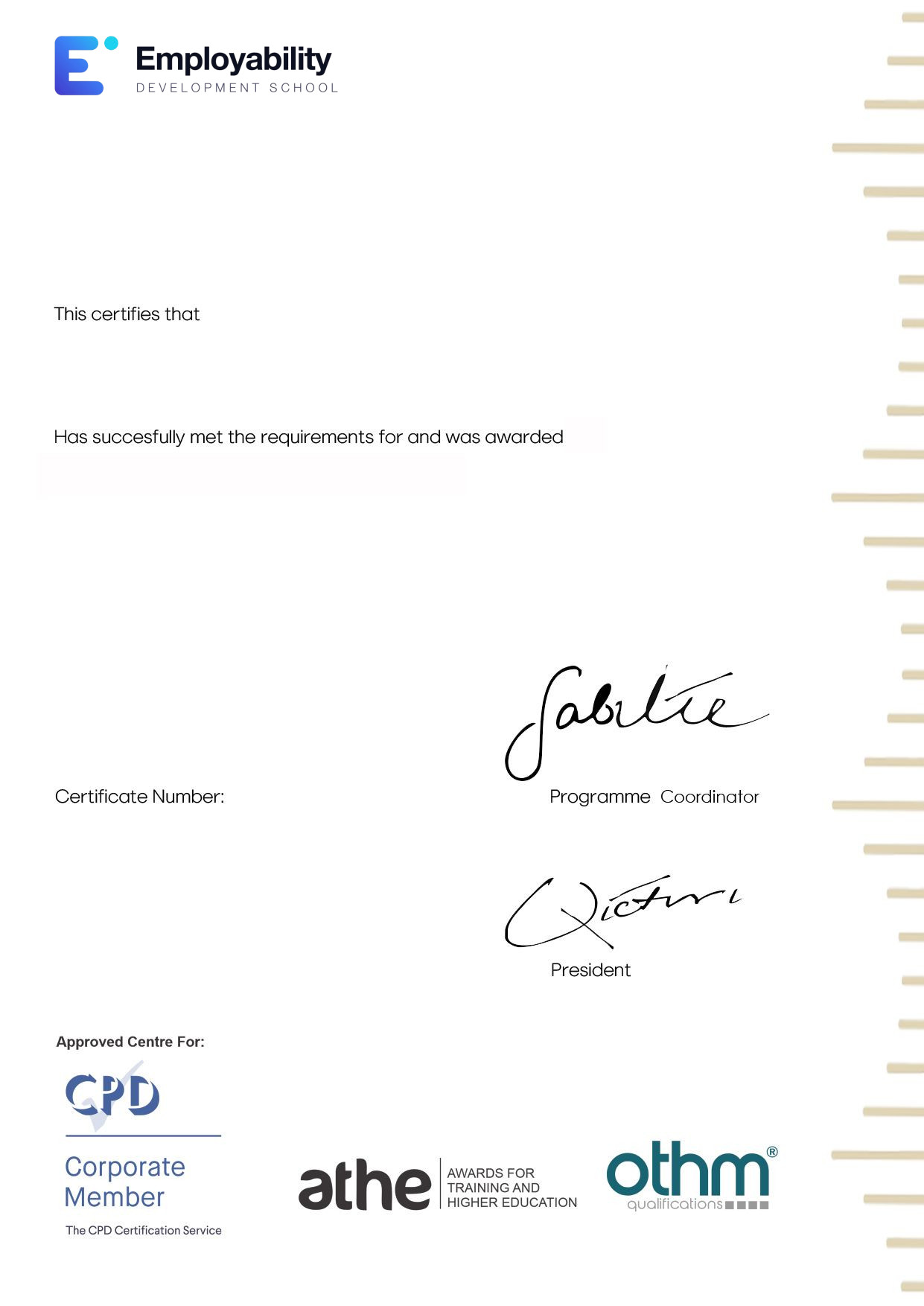
Sample Certificate
What you'll learn
Module 1
ASSIGNMENT & STUDY GUIDELINES
This module provides the most critical information about the study course and assignment submission.
Module 2
LOGISTICS MANAGEMENT
The module delves into the strategic significance of logistics within supply networks, emphasizing its value-adding role. Its objective is to provide learners with a comprehensive grasp of essential theoretical and operational elements pertaining to logistics management. This encompasses transportation, storage/warehousing, and packaging. Furthermore, it underscores the factors relevant to enhancing business competitiveness and operational efficiency, highlighting the intricate interplay between operational, technological, and regulatory facets.
Module 3
SUPPLY CHAIN PLANNING, MODELLING AND ANALYTICS
This module strives to furnish learners with comprehensive insights into the planning processes encompassing all critical facets of supply chain management. Within this module, individuals will have the opportunity to acquire a profound understanding of the pertinent models, theories, key performance indicators (KPIs), and tools used for evaluating and improving supply chain planning efficiency. The significance of each planning process, along with its corresponding data needs and techniques for modeling and analysis, will be addressed.
Module 4
PROCUREMENT AND SUPPLY MANAGEMENT
The module aims to offer learners a comprehensive grasp of procurement and supply management, encompassing strategic, technological, process, and relationship aspects. The objective is to impart knowledge about the procurement's role in supply chain management, strategies for evaluating sourcing alternatives, challenges related to negotiations and contracts with suppliers, efficient management of supplier relationships, and the technological advancements that facilitate procurement processes.
Module 5
SUPPLY CHAIN AND OPERATIONS STRATEGY
The objective of this module is to foster learners' comprehension of supply chain and operations management. This encompasses its breadth, influence, and significance, alongside the strategic choices necessitated in today's era of worldwide supply and global markets. These considerations take into account the primary factors that drive competitiveness. Within the module, various contexts are explored, delving into the practices and methodologies of supply chain and operations management.
Module 6
SUSTAINABLE OPERATIONS MANAGEMENT
The objective of this module is to enhance learners' grasp of sustainable operations management. This encompasses understanding the essential aspects of sustainability and their significance for businesses, recognizing the factors driving or hindering the adoption of sustainability, identifying opportunities for enhancing sustainability throughout the supply chain, and evaluating the performance metrics and business consequences associated with sustainability. We also delve into diverse industry sectors during this exploration.
Module 7
BUSINESS RESEARCH METHODS
The objective of this module is to enhance learners' comprehension of research principles. This encompasses crafting research proposals, conducting literature reviews, mastering referencing, acquiring skills in data collection through interviews and surveys, designing effective questionnaires, employing SPSS for statistical analysis, handling qualitative data, and adopting techniques to derive meaningful insights from the analyzed data.
How learners like you are achieving their goals
Participants in our courses don’t just learn new skills, they enjoy the experience too.

Zainab P.
EgyptExecutive Education
A smart way to enhance my knowledge within a short period of time, the course is very productive and beneficial for me...so grateful that i completed successfully...i would recommend my friends and family about the course.

Andrew S.
United StatesExecutive Education
Truly enjoyed the Strategic Management and Leadership Level 7 course and it provided me with a clear insight and helped me in my daily work as Plant Manager.

Richard T.
ScotlandExecutive Education
The modules were well structured, and gave me the knowledge to make sound decisions that maximize performance.

Rachel O.
NigeriaExecutive Education
I have learned a lot and gain experienced in this course. At first, I did not have confidence when standing front of audience but now, it is a different story.
Other related courses
Master of Arts (MA) in Management
This comprehensive training seminar empowers participants to foster tourism and make informed management choices in the field of tourism and destination management.
-
Access to this course.
-
Access to library.
-
Learn at your own pace.
-
Tests to boost your learning.
-
Digital certificate when eligible.

Course starts
Anytime
Completion time
12 Months
Limited time offer
MAD 48,353
MAD 87,035
MBA - Innovation and Entrepreneurship
The aim of the course is to provide students with a comprehensive understanding of innovation management and entrepreneurship in a globalized world.
-
Access to this course.
-
Access to library.
-
Learn at your own pace.
-
Tests to boost your learning.
-
Digital certificate when eligible.

Course starts
Anytime
Completion time
18 Months
Limited time offer
MAD 81,509
MAD 146,715
MBA - Engineering Management
The Advanced Professional Certificate program in System Analysis and Design is designed to acquaint the learner with the principles of system analysis and design, incorporating advanced project management techniques. This knowledge is crucial for effectively conceiving, developing, and implementing organizational systems.
-
Access to this course.
-
Access to library.
-
Learn at your own pace.
-
Tests to boost your learning.
-
Digital certificate when eligible.

Course starts
Anytime
Completion time
18 Months
Limited time offer
MAD 81,509
MAD 146,715
MA Human Resource Management (HRM)
The objective of the MA Human Resource Management (HRM) + Level 7 Diploma in Human Resource Management qualification is to provide learners with the skills and understanding in ...
-
Access to this course.
-
Access to library.
-
Learn at your own pace.
-
Tests to boost your learning.
-
Digital certificate when eligible.

Course starts
Anytime
Completion time
12 Months
Limited time offer
MAD 82,890
MAD 149,202