Doctor of Philosophy (PhD) in Business Management
The PhD programme enhances and polishes your ability to research business challenges in today's environment and recommend viable solutions.
Request follow-up
Fill in the form below and one of our student advisers will contact you soon.
Duration
36 Months
Pedagogy
Blended
Instalment
PKR 205,243 /month interest-free*
Total tuition
PKR 4,104,865
About the course
The PhD qualification or the Doctorate of Philosophy is widely regarded as the most prestigious and highest level of qualification awarded in academia. The PhD has a long-established reputation dating back to the 12th century. In the present day, the PhD still holds its value with PhD holders representing approximately under 0.1% of the worldwide population. In addition to being widely respected and prestigious, the PhD equips students with the research, practical and theoretical skills to work effectively in academia or industry.Therefore, our school in collaboration with its partner universities is proud to offer the PhD programme.
Duration: 3 Years
Total ECTS: 180
Course details
SUPERVISION AND MONITORINGPhD students joining our school are on a 3-year programme. However, a slight variation in the timeline is expected.
Once on the PhD programme, you will already be aware of your Principal and Second Supervisors that will be allocated based on subject specialisation. All students will be appointed a Departmental PhD Coordinator – who will exercise general academic and pastoral oversight of PhD students at our school, including your induction, supervision, progression and examination.
Students will be expected to meet their supervisors at least once a month. Students will be required to complete, sign and submit a meeting record which will be counter-signed by the supervisory team. The completed meeting records need to be emailed to our academics team. These meeting records will be filed and presented in staff meetings to assess whether the student has demonstrated a sufficient level of progress to be considered for a Viva exam. Progress of all students is monitored by a Thesis Committee consisting of your Principal Supervisor, Second Supervisor and the Departmental PhD coordinator. Students will be expected to meet with the Committee once at the end of the 1st year and once at the end of the 2nd year to demonstrate satisfactory progression. Students will be expected to submit a literature review draft at the end of the 1st year and present key findings from the literature review. Students are expected to submit a draft of the findings and analysis chapter by the end of the 2nd year, where they are expected to present key findings from the chapter. The Thesis Committee meetings are expected to last between 30-60 minutes.
PROGRESS OF PROGRAMME
The PhD programme will be divided into two segments. The first segment will consist of taught modules, and the second segment will be focused on the research and write-up leading to the submission of the PhD thesis. It should be noted that both segments will run in parallel to each other. You will be expected to attend all the taught modules while working on your Extended Research Proposal (ERP), followed by the literature review chapter draft.
Segment 1
The taught modules provide systematic continuous support in relation to the candidate’s skills and knowledge developed throughout their study. It allows candidates to reach a level playing field in terms of providing the foundation for doctoral-level research and knowledge of the related fields.
In the later part of the year, the student is to apply knowledge and understanding of research methodology to an actual pilot study and overall thesis proposal and to reflect on their own performance as a researcher.
Module Content
Each module covers a two-month period. Each module has 2 webinars attached to it. This is to provide students with an overall picture of how the component parts are related and the specific timings of key events. This includes research proposal and upgrade of Registration.
The modules study in stage 1 takes place over a 12-month period and:
- Provide the basis of continuous support for you to develop the skills and knowledge that form the basis of the research to be undertaken.
- Allow you to develop your thinking, reflection and writing skills and reflect on Management and business theory and practice.
- Form a development path that builds on each other to allow the research to be part of the process from the outset.
- Provide detailed formative and summative feedback that builds on each other.
- Through the assessments, which are built-in, not bolted-on, to the research project you are undertaking, work on key aspects of your research from day one.
Segment 2
It should be noted that Segment 2 will run in parallel to Segment 1, where the key milestones within Segment 2 are provided below.
YEAR 1
(0-3rd month) Extended Research Proposal (ERP): In the first few months, students will be required to submit an ERP, which will involve students demonstrating a contribution to knowledge, outline of research methodology and structure in terms of chapters related to the PhD thesis.
(3rd-12th month) Submission of Literature Review Chapter(s) Draft: Students will be required to write a contextual review on areas related to the research focus and a critical review of related studies as part of the literature review/background write-up.
(30-60 minutes at the end of 1st academic year) Thesis Committee Meeting: To progress into Year 2, it will be mandatory for students to submit a literature review draft by the end of the academic year and satisfy academic staff at the Thesis Committee meeting via a presentation. In the case of failure, students will be granted the opportunity to convert the literature review chapter draft into an MPhil thesis within a 6 month period to qualify for an MPhil qualification.
YEAR 2
(0-3rd month) Submission of Research Methodology Chapter Draft/Ethical Approval: Students will be required to write up and submit a draft of the research methodology chapter while waiting for ethical approval from the academic staff to conduct the empirical research.
(3rd-6th month) Data collection and analysis: Students will be authorized to conduct the empirical research, where they will be expected to transcribe and analyse the retrieved data during this stage.
(6th-12th month) Submission of Findings and Analysis Chapter(s) Draft: Students will be required to submit a draft of the findings and analysis chapter by the end of the academic year, which will be subject to review by the academic staff.
(30-60 minutes at the end of 2nd academic year) Thesis Committee Meeting: The student will present the key findings from the findings and analysis chapter to the academic team to demonstrate their progress in the PhD programme.
YEAR 3
(0-3rd month) Submission of Discussion Chapter Draft: Students will be expected to submit the discussion chapter within the first 3 months, which will consist of demonstrating a contribution to knowledge as well as the realization of the research aim and objectives.
(3rd-6th month) Submission of Conclusions and Recommendations Chapter Draft.
(6th- 9th month) Submission of Introduction Chapter Draft.
(0-12th month) Final write-up: Year 3 will be an opportunity for students to review and update chapters while writing up and awaiting feedback for other chapters.
(During the 12th month) Final submission: Students will be required to submit the final draft of a 60,000-80,000 word thesis document which will be examined by an internal and external examiner.
(6-8 weeks after final submission) Viva Exam: This meeting will involve a meeting between the internal and external examiners with the PhD student where there will be a senior member of staff acting as chair for the Viva. Additionally, one of the PhD supervisors will be allowed to attend the viva as a silent/non-participating attendant.
Student Grievances and Complaints
If you have any concerns about your supervision, progression, etc, please discuss these with the Departmental PhD Coordinator at the earliest possible opportunity.
If you feel that a member of staff has unfairly treated you in any way, please raise it first with that member of staff. If that is inappropriate, then see the Departmental PhD Coordinator, who can also advise on any difficulties (personal, financial, medical or academic) affecting your studies.
RESEARCH ETHICS
It is your responsibility to make sure that you have ethical permission in place in the form of ethical approval by academic staff before performing research where this is required. Please refer to the research ethics page on the MBSM website for more information.
RESEARCH INTEGRITY
Being a researcher involves a high level of ethical standards and integrity in one’s work and interactions with others. MBSM takes integrity very seriously and misconduct in research can be very damaging for individuals and the institution as a whole.
Accreditation
All of our courses are accredited by the relevant partners and awarding bodies. Please refer to our information in about us for more details.Entry requirement
- Students need to have a Masters qualification with a minimum Merit (60%) pass.
- Students are required to submit an up to date CV.
- Students need to submit a brief Research Proposal (500 words) consisting of the sections of Background (brief literature review), Research Rationale (what is the contribution to knowledge from the proposed research study and why is it important?), Aim and Objectives and Research Methodology (follow Saunders’ Research Onion layers).
- 1 professional and 1 academic reference is required.
- Bachelor's and Master's degree certificates and transcripts.
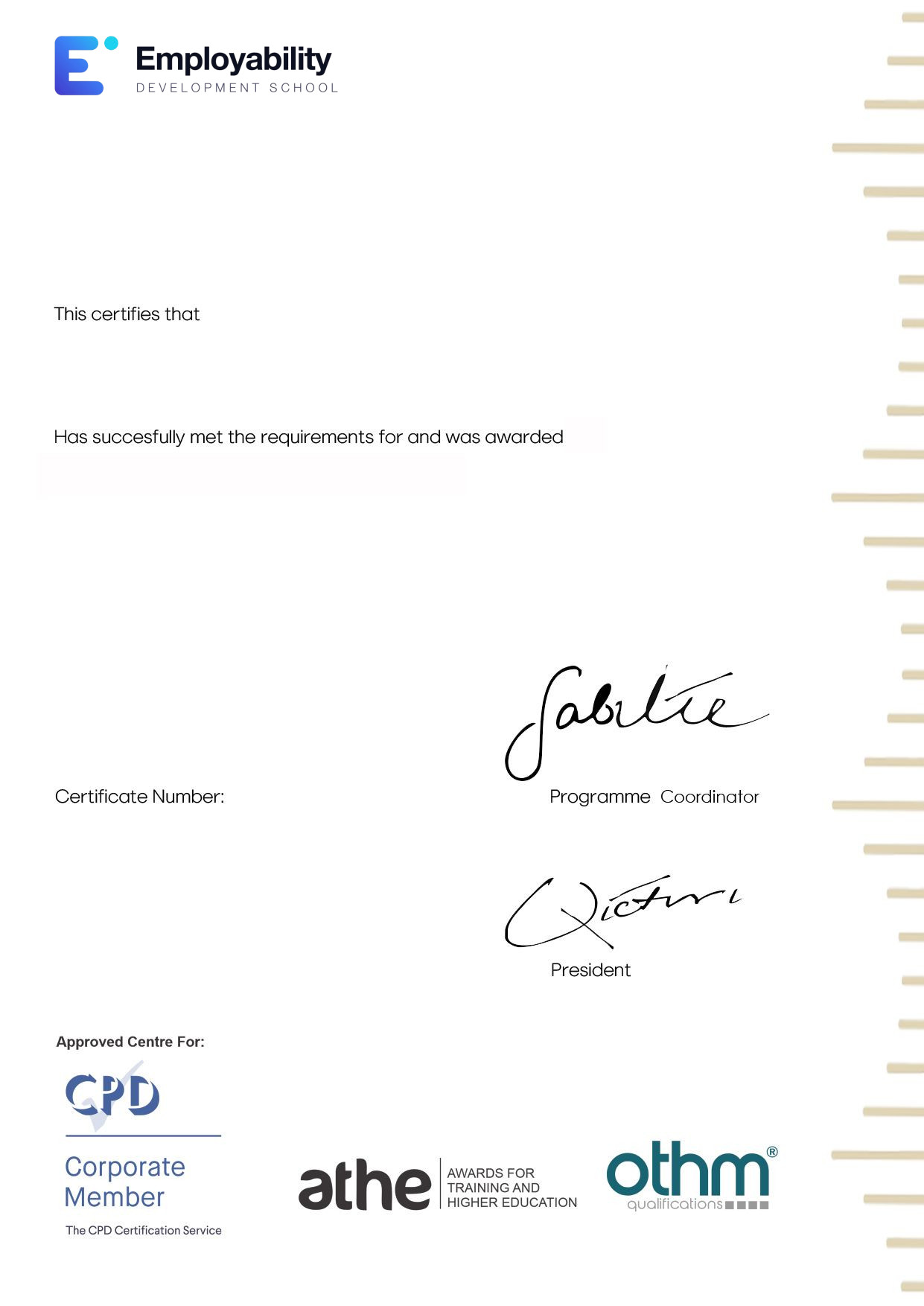
Sample Certificate
What you'll learn
Module 1
ASSIGNMENT & STUDY GUIDELINES
This module provides the most critical information about the study course and assignment submission.
Module 2
ADVANCED RESEARCH METHODS
This module aims to provide students with the necessary qualitative and quantitative foundations to conduct advanced research at the doctoral level. It encompasses a comprehensive examination of research principles, which involves a critical analysis of theoretical concepts rooted in Research Philosophy and Research Approach. Furthermore, it delves into practical research principles encompassing Research Strategy, Data Collection Methodology, and Data Analysis Techniques. Moreover, students will gain the skills to exercise ethical judgment throughout their doctoral research endeavors.
Module 3
ADVANCED HUMAN RESOURCE MANAGEMENT
This module focuses on the effective management of personnel within a multifaceted organization, encompassing tasks such as recruitment, selection, training, promotion, and motivation of individuals. It also involves nurturing personal allegiance and overseeing staff to enhance their individual contributions, thereby elevating quality standards while concurrently reducing operational expenses.
Module 4
STRATEGIC MANAGEMENT AND BUSINESS ANALYSIS
The course offers conceptual frameworks and models that aid students in analyzing competitive scenarios and strategic challenges, fostering an understanding of strategic management. This program will integrate prior course content across the business curriculum. Case studies complement the lectures.
Module 5
ADVANCED BUSINESS THEORIES
The objective of this course is to assist PhD candidates in cultivating an appreciation for the evolution of business as an academic discipline. Throughout the course, students will delve into the historical progression of this field, transitioning from its economic roots to a more behaviorally-oriented approach. Through the analysis of numerous articles on each subject, students will not only develop an insight into the process of academic knowledge formation but also become familiar with contemporary methods employed in the realm of social science.
Module 6
GLOBAL FINANCIAL MANAGEMENT
The aim of this course is to impart the fundamental principles of asset valuation and financing within the dynamic realm of global financial markets. The course structure centers on the core concepts of Finance, including the crucial factors of the time value of money, risk and diversification, as well as arbitrage and hedging strategies. The time value of money stands as a fundamental element influencing the valuation of various assets, ranging from bonds and stocks to futures and options. Our discussions on diversification and risk delve deep into the intricate relationship between risk and return as delineated by modern portfolio theory. Within the context of arbitrage and hedging, we elucidate effective approaches for mitigating market risk, interest rate risk, and foreign exchange risk, all of which encompass the utilization of futures and options.
Module 7
ORGANIZATIONAL BEHAVIOUR
Theoretical statements of individual and group behaviour in organizations will be examined in this course. Student presentations and discussions will include detailed treatments of organization design, change, and reorganization, as well as inter-organizational relationships.
Module 8
ADVANCED MANAGEMENT
This module encapsulates the core principles of advanced research in business management, encompassing a wide array of topics. These encompass the analysis of contemporary management theories, the evolution of organizational structures, the intricacies of organizational behavior, and its connection to efficient administration. Additionally, the module explores models relating to communication, motivation, and leadership within the realm of business management.
Module 9
Segment 2 - RESEARCH/THESIS
Here, in this segment, you will produce an academic standard research report. This segment will last nominally for two years.
How learners like you are achieving their goals
Participants in our courses don’t just learn new skills, they enjoy the experience too.

Zainab P.
EgyptExecutive Education
A smart way to enhance my knowledge within a short period of time, the course is very productive and beneficial for me...so grateful that i completed successfully...i would recommend my friends and family about the course.

Andrew S.
United StatesExecutive Education
Truly enjoyed the Strategic Management and Leadership Level 7 course and it provided me with a clear insight and helped me in my daily work as Plant Manager.

Richard T.
ScotlandExecutive Education
The modules were well structured, and gave me the knowledge to make sound decisions that maximize performance.

Rachel O.
NigeriaExecutive Education
I have learned a lot and gain experienced in this course. At first, I did not have confidence when standing front of audience but now, it is a different story.
Other related courses
DBA - PhD in Marketing
The course is designed to acquaint learners with the principles, dimensions, and models of customer service. It offers valuable insights into developing effective strategies for enhancing customer service approaches.
-
Access to this course.
-
Access to library.
-
Learn at your own pace.
-
Tests to boost your learning.
-
Digital certificate when eligible.

Course starts
Anytime
Completion time
36 Months
Limited time offer
PKR 4,104,865
PKR 7,388,757
DBA - PhD in Quality Management
This essential course acquaints the learner with the fundamental concept of understanding the significance of critical thinking in the process of problem-solving and conducting research to make well-informed decisions.
-
Access to this course.
-
Access to library.
-
Learn at your own pace.
-
Tests to boost your learning.
-
Digital certificate when eligible.

Course starts
Anytime
Completion time
36 Months
Limited time offer
PKR 4,104,865
PKR 7,388,757
DBA - PhD in Healthcare Management
The course offers learners a comprehensive understanding of various systems, principles, and mechanisms employed to safeguard and maintain the safety and hygiene of food.
-
Access to this course.
-
Access to library.
-
Learn at your own pace.
-
Tests to boost your learning.
-
Digital certificate when eligible.

Course starts
Anytime
Completion time
36 Months
Limited time offer
PKR 4,104,865
PKR 7,388,757
DBA and MBA (Integrated Doctorate)
This dual Degree programme, DBA and MBA is designed to offer a streamlined and cost-effective educational pathway that can be completed in just 2.5 years. We prioritize careful planning and streamlined curriculum options to optimize your educational investment.
-
Access to this course.
-
Access to library.
-
Learn at your own pace.
-
Tests to boost your learning.
-
Digital certificate when eligible.

Course starts
Anytime
Completion time
36 Months
Limited time offer
PKR 5,082,214
PKR 9,147,984