MSc Accounting and Finance
The objective of the MSc Accounting and Finance + Level 7 Diploma in Accounting and Finance qualification is to provide learners with an understanding of...
Request follow-up
Fill in the form below and one of our student advisers will contact you soon.
Duration
12 Months
Pedagogy
Blended
Instalment
PGK 2,314 /month interest-free*
Total tuition
PGK 30,855
About the course
Stage One: Level 7 Diploma in Accounting & Finance (RQF) – 6 - 8 Months
Credits: 120 Credits
The Level 7 Diploma in Accounting and Finance qualification also provides learners with the opportunity to work toward a relevant master’s programme with advanced standing.
Stage Two: MSc in Accounting & Finance Top-up– 4 – 6 Months
Credits: 60 Credits
Assessment: Dissertation
The MSc Accounting and Finance (Top-up) aims to extend and enhance the understanding and competence gained via professional qualifications and to enhance the ability of students to think strategically about management and organizational change within accounting and finance.
This programme is designed for Level 7 (Postgraduate) Diploma in Accounting & Finance graduates and provides a means by which the continuing professional and personal needs of accounting practitioners can be met.
This programme will broaden your specialist knowledge previously gained at a professional level. In particular, the module, ‘Accounting & finance research project’ guides you to research into the key challenges accounting and finance professionals face in the industry. This module aims to equip accounting and finance professionals with the necessary skills to undertake independent project work within a business context. The Research Methods element provides you with an introduction to research, types of research methodology, formulating and planning a research project, data collection, analysis, and presentation of research findings based upon an actual industry-specific or corporate focused topic.
Course details
Objectives:
- contemporary and specialized approaches to accountancy and finance
- key practical, theoretical and empirical issues, and academic research
- the complexity of the ever-changing legal framework in which the financial sector operates
- the latest developments in accountancy and reporting required by local, national and European governments.
This qualification is designed for learners who wish to pursue a career in the financial services industry, professional accountancy, banking, and finance or management. The qualification equips learners with the essential skills and knowledge needed to pursue high-level careers in all types of organizations in the public and private sector and within industry and commerce, both in the UK and abroad.
Accreditation
All of our courses are accredited by the relevant partners and awarding bodies. Please refer to our information in about us for more details.
Entry requirement
For entry onto the Level 7 Diploma in Human Resource Management leading to the MA Human Resource Management qualification, learners must possess:
- An honours degree in related subject or UK level 6 diploma or equivalent overseas qualification i.e. Bachelors Degree or Higher National Diploma
- Mature learners (over 25) with at least 5 years of management experience if they do not possess the above qualification (this is reviewed on a case by case basis)
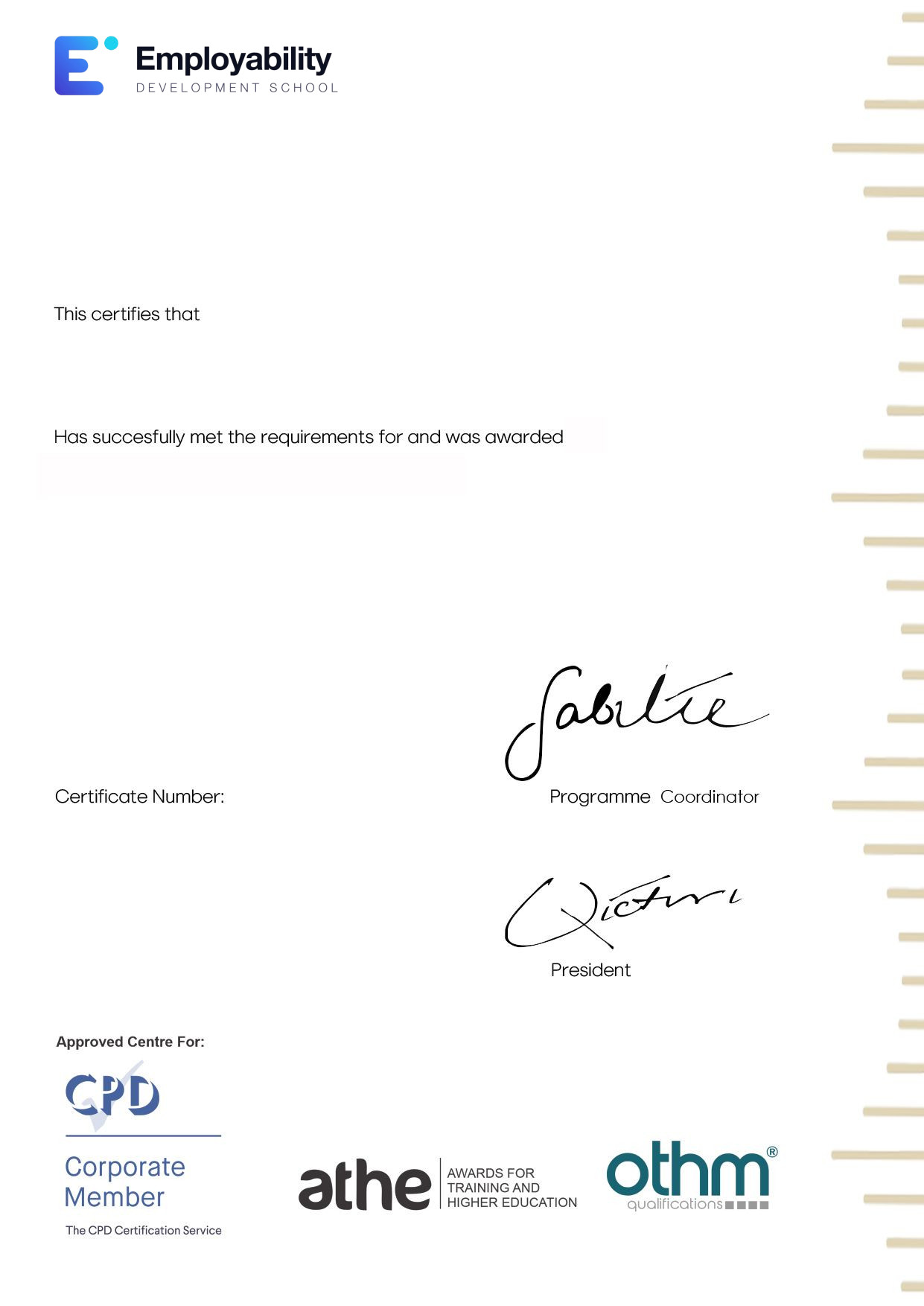
Sample Certificate
What you'll learn
Module 1
ASSIGNMENT & STUDY GUIDELINES
This module provides the most critical information about the study course and assignment submission.
Module 2
INVESTMENT ANALYSIS
The objective of this unit is to enhance learners' comprehension of investment theories and market equilibrium models. This encompasses the need to conduct bond valuations and analyze the current performance of investments. Upon successfully finishing this unit, learners will possess the capabilities to thoughtfully analyze the impact of global developments on capital markets and provide valuable recommendations for future investments.
Module 3
CORPORATE REPORTING
The objective of this unit is to enhance learners' proficiency in the preparation and interpretation of financial statements for various business entities. Learners will acquire the capability to apply pertinent accounting principles and concepts. This unit presents learners with a chance to improve both their quantitative and qualitative analytical abilities by examining and deciphering financial information.
Module 4
GLOBAL FINANCE & STRATEGY
The aim of this unit is to develop learners’ understanding of the types of decisions that need to be taken when entering global markets. Learners will gain an understanding of why independence in solving financial issues within a specific period of time is vital for business success.
Module 5
STRATEGIC FINANCIAL MANAGEMENT
Upon successful completion of this unit, participants will have acquired a solid grasp of effectively planning and overseeing the allocation of financial resources within a corporate entity. They will recognize the significance of achieving organizational goals and optimizing returns for stakeholders. Participants will also acquire practical insights into crafting business strategies and formulating all-encompassing business blueprints.
Module 6
STRATEGIC AUDIT
The goal of this unit is to enhance learners' comprehension of how managers can effectively align and implement business strategies. This will encompass a comprehensive examination of the strategic auditing process and its associated protocols. Learners will gain the capability to grasp and employ appropriate investigative methods in diverse business contexts.
Module 7
BUSINESS RESEARCH METHODS
The objective of this unit is to enhance learners' comprehension of research principles. This encompasses crafting research proposals, conducting literature reviews, mastering referencing techniques, employing interviews and surveys for data collection, designing effective questionnaires, utilizing SPSS for statistical analysis, handling qualitative data, and devising approaches to derive conclusions from the analyzed information.
How learners like you are achieving their goals
Participants in our courses don’t just learn new skills, they enjoy the experience too.

Zainab P.
EgyptExecutive Education
A smart way to enhance my knowledge within a short period of time, the course is very productive and beneficial for me...so grateful that i completed successfully...i would recommend my friends and family about the course.

Andrew S.
United StatesExecutive Education
Truly enjoyed the Strategic Management and Leadership Level 7 course and it provided me with a clear insight and helped me in my daily work as Plant Manager.

Richard T.
ScotlandExecutive Education
The modules were well structured, and gave me the knowledge to make sound decisions that maximize performance.

Rachel O.
NigeriaExecutive Education
I have learned a lot and gain experienced in this course. At first, I did not have confidence when standing front of audience but now, it is a different story.
Other related courses
Master of Arts (MA) in International Management
This comprehensive course aims to impart practical how-to guides, contemporary facility management techniques, strategies, and methods that facility managers can readily implement.
-
Access to this course.
-
Access to library.
-
Learn at your own pace.
-
Tests to boost your learning.
-
Digital certificate when eligible.

Course starts
Anytime
Completion time
12 Months
Limited time offer
PGK 17,999
PGK 32,398
MBA - Human Resource Management
MBA in Human Resource Management qualification aims to prepare learners to understand and apply advanced concepts in human resource management, develop skills to design and implement effective HR strategies,
-
Access to this course.
-
Access to library.
-
Learn at your own pace.
-
Tests to boost your learning.
-
Digital certificate when eligible.

Course starts
Anytime
Completion time
18 Months
Limited time offer
PGK 30,341
PGK 54,613
MA Human Resource Management (HRM)
The objective of the MA Human Resource Management (HRM) + Level 7 Diploma in Human Resource Management qualification is to provide learners with the skills and understanding in ...
-
Access to this course.
-
Access to library.
-
Learn at your own pace.
-
Tests to boost your learning.
-
Digital certificate when eligible.

Course starts
Anytime
Completion time
12 Months
Limited time offer
PGK 30,855
PGK 55,539
MBA - International Marketing
The aim of the International Marketing course is to provide students with a comprehensive understanding of the theories, practices, and strategies involved in marketing goods and services across international borders.
-
Access to this course.
-
Access to library.
-
Learn at your own pace.
-
Tests to boost your learning.
-
Digital certificate when eligible.

Course starts
Anytime
Completion time
18 Months
Limited time offer
PGK 30,341
PGK 54,613