MBA - Supply Chain Management
To provide a comprehensive understanding of supply chain and sourcing management, including strategic management, procurement and sourcing, logistics and transportation, and inventory management.
Request follow-up
Fill in the form below and one of our student advisers will contact you soon.
Duration
18 Months
Pedagogy
Blended
Instalment
WST 1,668 /month interest-free*
Total tuition
WST 22,237
About the course
The Master of Business Administration (MBA) - Supply Chain Management is delivered in two stages.
Stage One: This stage is taught and delivered by our and contains SIX modules of 30 ECTS: - 6 - 8 Months
Credits: 30 ECTS
Stage Two: This stage is delivered online/on-campus by our partner university with a study of 30 ECTS: 4 - 6 Months
Credits: 30 ECTS
Assessment: Assignment/Project/Dissertation
To provide a comprehensive understanding of supply chain and sourcing management, including strategic management, procurement and sourcing, logistics and transportation, and inventory management, with a focus on optimizing overall supply chain performance and efficiency.
Module Content:
- Strategic Management
- Business Ethics and Corporate Governance
- Operations and Information Management
- Supply Chain and Sourcing Management
- Aspects of International Management
Course details
As the recent global disruptions in supply chains have demonstrated clearly, our increasingly globalised world makes the job of supply chain managers considerably more complex - and considerably more vital.
An excellent supply chain manager can help companies navigate through these challenges successfully, and is therefore a real asset to businesses. If you’re ready to take on these opportunities to test yourself, IU International University of Applied Sciences' online MBA with a specialisation in Supply Chain Management will prepare you to excel in any industry that requires international logistics.
Accreditation
All of our courses are accredited by the relevant partners and awarding bodies. Please refer to our information in about us for more details.Entry requirement
For entry onto the Master of Business Administration (MBA) qualification, learners must possess the following:
- Completed undergraduate degree with 180 ECTS.
- Your degree must be from a state or state-recognised higher education institution/university.
- You must have achieved a final grade of at least “satisfactory” or Grade C equivalent in your previous undergraduate degree.
- Proof of at least one year’s professional work experience completed prior to the start of the study programme. Work experience must have been gained after the completion of your undergraduate studies.
The admissions documents must be provided in English or German, if they were not issued in one of these two languages, a translation is required.
English Language Skills:
Is English your native language or have you graduated from an English-speaking school or university? Then you do not need to prove your English language skills.
You can prove your English skills with an English B2 level certificate (no older than 5 years). Don’t have this at hand? No problem! You can quickly get your English certified with Duolingo.
- Take the online test in just 45 to 60 minutes
- Receive your certified results within 2 days
- Save valuable money and time
We also accept the following English language skills certificates:
- TOEFL (minimum 80 points) or
- IELTS (minimum Level 6) or
- Cambridge Certificate (minimum Grade B)
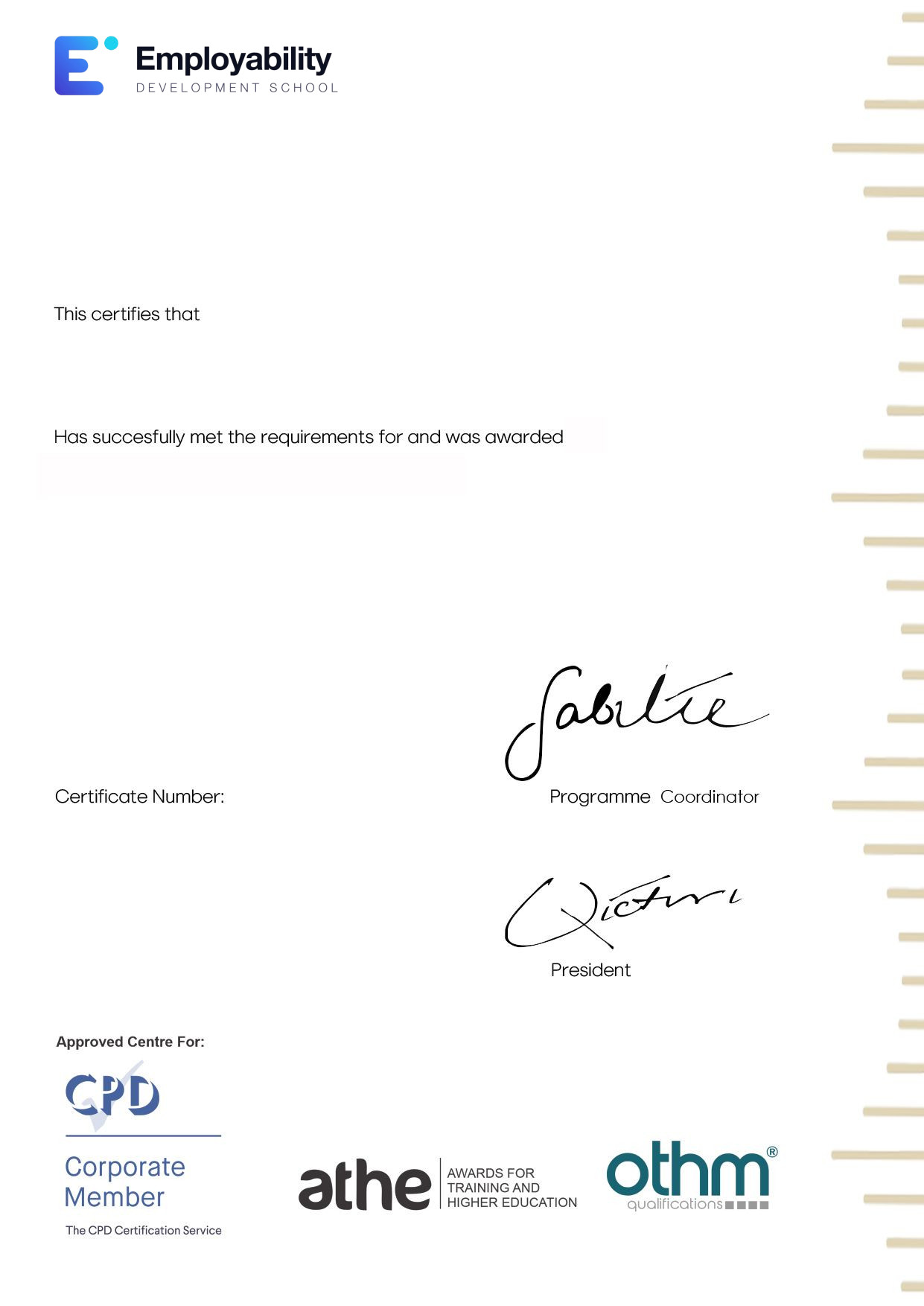
Sample Certificate
What you'll learn
Module 1
ASSIGNMENT & STUDY GUIDELINES
This module provides the most critical information about the study course and assignment submission.
Module 2
Leadership
In contemporary society, personnel stands as a firm's most prized resource. A fundamental duty of leadership involves elevating the wisdom, proficiencies, and capabilities of the workforce. Proficient leadership is indispensable for a corporation's enduring triumph amid escalating market rivalry. This course imparts proficiency in contemporary, knowledge-centric organizational leadership by addressing key inquiries in leadership theory and its real-world implementation, with a focus on strategic management and transformative procedures.
Module 3
Innovation And Entrepreneurship
The focus of our Innovation and Entrepreneurship program is to educate students on the principles, practices, and mindset necessary for the creation of new ventures and the introduction of fresh ideas to the market. Our goal is to equip students with the skills to identify and assess opportunities for new businesses and to formulate comprehensive plans for their successful realization.
Module 4
International Marketing
Global marketing seeks to foster a holistic comprehension of the worldwide business landscape, as well as the approaches and methods employed to effectively market goods and services on a global scale. This encompasses grasping distinctions in culture and economics, scrutinizing global market patterns and openings, crafting potent marketing mix strategies, and acclimating to diverse legal and regulatory landscapes. It further empowers enterprises to pinpoint fresh markets and customer sectors, as well as to cultivate and sustain prosperous connections with global associates and stakeholders.
Module 5
Managerial Economics
This module is designed to offer insight into fundamental principles and concepts of micro and macroeconomic theory and how they are applied in the realm of management. It equips learners with the necessary economic analysis tools and techniques that are frequently employed by managerial professionals for decision-making. Additionally, it fosters the capacity to assess and address economic challenges encountered by businesses and organizations.
Module 6
Performance Measurement
The module focused on performance measurement aims to equip learners with the necessary knowledge and skills for comprehending and applying performance measurement systems within organizations. This entails grasping various categories of performance measures and metrics, pinpointing pivotal performance indicators, making suitable selections of measures and metrics, and crafting efficient performance measurement systems.
Module 7
Corporate Finance
Corporate Finance aims to guide students on the complexities of corporate-level financial decisions.
How learners like you are achieving their goals
Participants in our courses don’t just learn new skills, they enjoy the experience too.

Zainab P.
EgyptExecutive Education
A smart way to enhance my knowledge within a short period of time, the course is very productive and beneficial for me...so grateful that i completed successfully...i would recommend my friends and family about the course.

Andrew S.
United StatesExecutive Education
Truly enjoyed the Strategic Management and Leadership Level 7 course and it provided me with a clear insight and helped me in my daily work as Plant Manager.

Richard T.
ScotlandExecutive Education
The modules were well structured, and gave me the knowledge to make sound decisions that maximize performance.

Rachel O.
NigeriaExecutive Education
I have learned a lot and gain experienced in this course. At first, I did not have confidence when standing front of audience but now, it is a different story.
Other related courses
MBA - Big Data Management
The Advanced Professional Certificate in Strategic Business Management aims to empower learners with a comprehensive grasp of fundamental strategic management concepts and the pivotal role that strategy plays within a business context.
-
Access to this course.
-
Access to library.
-
Learn at your own pace.
-
Tests to boost your learning.
-
Digital certificate when eligible.

Course starts
Anytime
Completion time
18 Months
Limited time offer
WST 22,237
WST 40,027
Executive Master of Business Administration (EMBA) in Media and Entertainment
The programme's objective is to equip you with a deeper understanding of entertainment management and media communication strategies...
-
Access to this course.
-
Access to library.
-
Learn at your own pace.
-
Tests to boost your learning.
-
Digital certificate when eligible.

Course starts
Anytime
Completion time
12 Months
Limited time offer
WST 18,845
WST 33,921
Master of Arts (MA) in International Healthcare Management
This comprehensive training seminar prepares participants to manage and oversee business operations effectively.
-
Access to this course.
-
Access to library.
-
Learn at your own pace.
-
Tests to boost your learning.
-
Digital certificate when eligible.

Course starts
Anytime
Completion time
12 Months
Limited time offer
WST 13,192
WST 23,745
Master of Business Administration (MBA)
The Advanced Professional Certificate in Strategic Financial Management is designed to empower learners with the ability to strategically oversee an organization's finances. This is achieved through the acquisition of fundamental knowledge and skills in areas such as financial statement analysis, identification and assessment of funding sources, cost analysis and control, and the preparation and analysis of financial budgets. These skills are applied using appropriate accounting practices to drive the strategic success of the organization.
-
Access to this course.
-
Access to library.
-
Learn at your own pace.
-
Tests to boost your learning.
-
Digital certificate when eligible.

Course starts
Anytime
Completion time
12 Months
Limited time offer
WST 13,192
WST 23,745