DBA - PhD in Healthcare Management
The course offers learners a comprehensive understanding of various systems, principles, and mechanisms employed to safeguard and maintain the safety and hygiene of food.
Request follow-up
Fill in the form below and one of our student advisers will contact you soon.
Duration
36 Months
Pedagogy
Blended
Instalment
ZAR 13,141 /month interest-free*
Total tuition
ZAR 262,820
About the course
The course presents learners with various insights into the systems, principles, and functions of diverse mechanisms for ensuring the safety and hygiene of food. It equips learners to comprehend and apply skills related to the identification, management, and prevention of food safety and hygiene hazards.Upon successfully completing the course, you will acquire knowledge in the following areas:
- Research conducted by the Food Standards Agency
- Responsibilities of Meat Hygiene Inspectors
- Diverse Methods of Detection
- The functions of Meat Hygiene Inspectors
- Principles and Procedures of Hazard Analysis Critical Control Points
- Development of food safety plans
- The involvement of different stakeholders in safety control
Course details
The course is delivered in two segments.
Segment 1 consists of Seven modules, each one with an assignment and Segment 2 consists of a RESEARCH REPORT(paper)
Segment 1:
Modules: You will be awarded a level 8 Diploma for the completion of the coursework of the following modules.
ADVANCED RESEARCH METHODS:
This module will equip students with the qualitative and quantitative principles to undertake research at the doctorate level. The research principles will include a review of theoretical principles informed by Research Philosophy and Research Approach along with empirical research principles involving Research Strategy, Data Collection Method and Data Analysis Method. Additionally, students will be equipped to make appropriate judgements based on ethical practices during the PhD research.
ADVANCED HUMAN RESOURCE MANAGEMENT:
This module will aim at the management of human beings in a complex organisation; recruiting, selecting, training, promoting & motivating human beings. Increasing personal loyalties & managing personnel to elevate individual contribution, increasing quality & lowering operational costs.
STRATEGIC MANAGEMENT AND BUSINESS ANALYSIS:
The course presents conceptual frameworks and models which will assist students in analyzing competitive situations and strategic dilemmas and gaining insight into strategic management. This course will synthesise previous course materials within the business programmes. Lectures are supplemented with case studies.
ADVANCED BUSINESS THEORIES:
The course aims at helping PhD candidates develop an appreciation for the intellectual growth of business as a discipline. Students will have an opportunity to view the historical growth of the field from an economic to a behaviourally-based discipline. By studying multiple articles on each topic, students will gain an understanding of the way academic knowledge is developed, as well as be exposed to contemporary social science methods.
GLOBAL FINANCIAL MANAGEMENT:
This module aims to provide the principles of asset valuation and financing in competitive global financial markets. The course is organized around the three main ideas in Finance: The time value of money, Diversification and risk, Arbitrage and hedging. The time value of money is a basic determinant in the valuation of assets such as bonds, stocks, futures, and options. The classes on diversification and risk provide a thorough grounding in the trade-off between risk and return given by modern portfolio theory. In discussing arbitrage and hedging, we demonstrate how to hedge market, interest rate, and foreign exchange risks. This involves using futures and options.
ORGANIZATIONAL BEHAVIOUR:
Theoretical statements of individual and group behaviour in organizations will be examined in this course. Student presentations and discussions will include detailed treatments of organization design, change, and reorganization, as well as inter-organizational relationships.
ADVANCED MANAGEMENT:
This module captures the essence of research in advanced theory and practice of business management that include areas such as Analysis of modern management theories, Development of organizations, Dynamics of organizational behaviour and relationship to effective administration in addition to the Models of communication, motivation, and leadership.
Segment 2 - RESEARCH/THESIS:
Here, you will produce an academic standard research report in this segment. This segment will last nominally for one-two year. Your specialization depends on the topic you will select for the research.
Accreditation
All of our courses are accredited by the relevant partners and awarding bodies. Please refer to our information in about us for more details.Entry requirement
Entry requirements for this course are not stringent. Possessing work experience can provide an additional advantage in comprehending the course content.The certificate program aims to augment the learner's expertise in the field. It is suitable for individuals seeking to expand their understanding and stay informed about contemporary concepts within their respective domains. We suggest this certificate program for the following target audience:
- CEOs, Directors, Managers, and Supervisors
- Professionals in the Hospitality Management sector
- Those in Food and Safety Management roles
- Restaurant Managers
- Chefs
- Food Inspectors
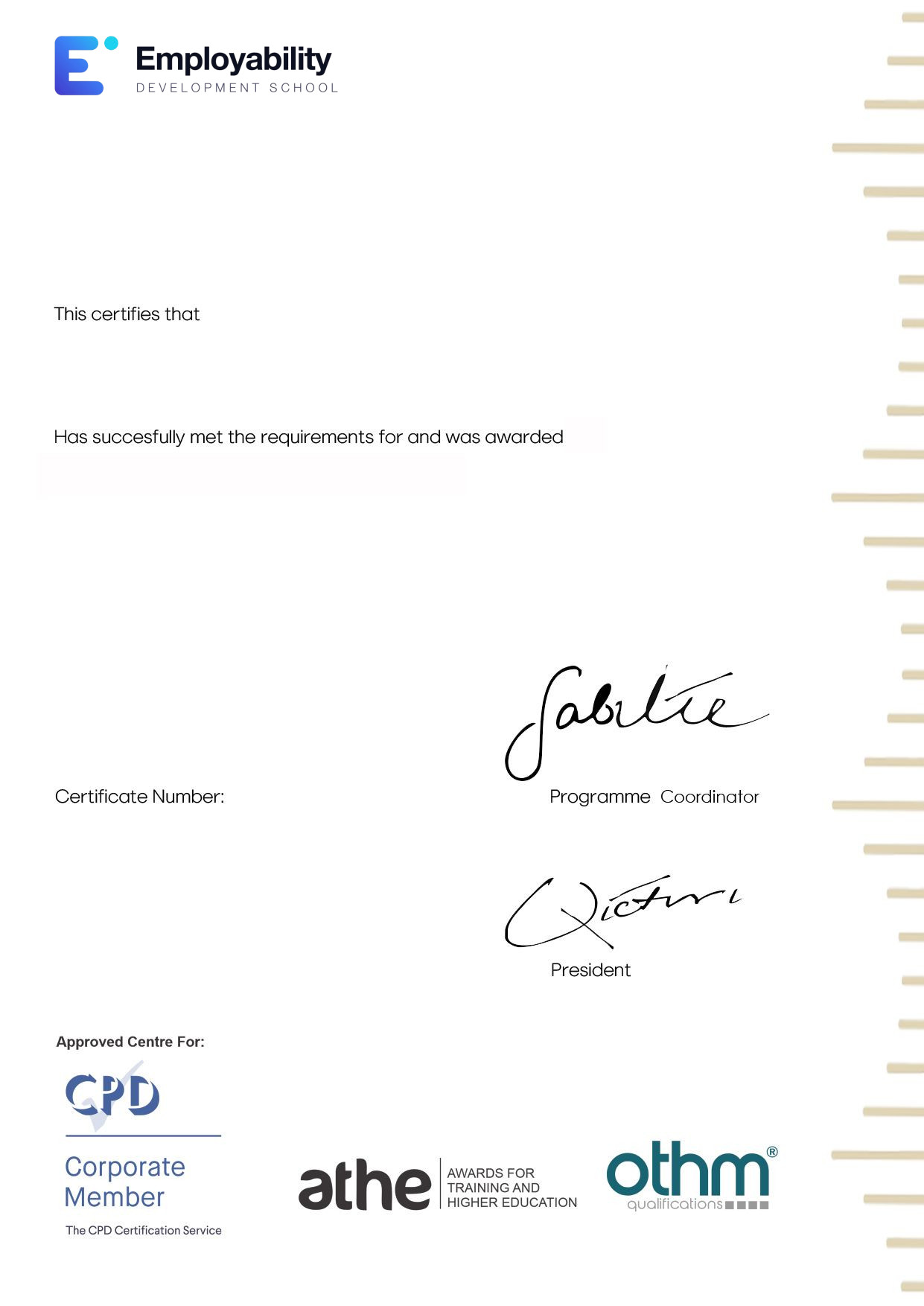
Sample Certificate
What you'll learn
Module 1
ASSIGNMENT & STUDY GUIDELINES
This module provides the most critical information about the study course and assignment submission.
Module 2
ADVANCED RESEARCH METHODS
This module aims to provide students with the necessary qualitative and quantitative foundations for conducting advanced research at the doctoral level. These foundational principles encompass a comprehensive exploration of theoretical underpinnings guided by Research Philosophy and Research Approach, as well as practical research principles covering Research Strategy, Data Collection Methodology, and Data Analysis Techniques. Furthermore, students will gain the ability to exercise ethical judgment when conducting their doctoral research.
Module 3
ADVANCED HUMAN RESOURCE MANAGEMENT
This module focuses on effectively managing individuals within a complex organization. It encompasses various aspects such as recruitment, selection, training, promotion, and motivation of personnel. The goal is to enhance personal loyalty and oversee personnel to enhance their individual contributions, ultimately improving quality and reducing operational costs.
Module 4
STRATEGIC MANAGEMENT AND BUSINESS ANALYSIS
The course introduces conceptual frameworks and models that will aid students in analyzing competitive situations and strategic challenges, enabling them to gain valuable insights into strategic management. This educational program will amalgamate prior course content from within the business curriculum. Case studies complement the lectures.
Module 5
GLOBAL FINANCIAL MANAGEMENT
The goal of this course is to impart the fundamental principles governing asset valuation and financing within the competitive landscape of global financial markets. This course is structured around three core concepts in the field of Finance: The concept of the time value of money, the dynamics of Diversification and risk management, and the strategies of Arbitrage and hedging. The time value of money plays a pivotal role in assessing the worth of various assets such as bonds, stocks, futures, and options. Our lessons on diversification and risk delve deep into the delicate balance between risk and return, as elucidated by modern portfolio theory. In our discussions on arbitrage and hedging, we elucidate techniques for mitigating market risk, interest rate risk, and foreign exchange risk, employing instruments like futures and options.
Module 6
ORGANIZATIONAL BEHAVIOUR
In this course, we will delve into theoretical concepts related to individual and group behavior within organizational contexts. Student presentations and discussions will encompass comprehensive discussions on topics such as organization design, change management, and reorganization, along with exploring inter-organizational relationships.
Module 7
ADVANCED BUSINESS THEORIES
The course is designed to assist PhD candidates in cultivating an appreciation for the intellectual evolution of the business discipline. Throughout this course, students will delve into the historical progression of this field, transitioning from an economic-centered approach to one grounded in behavioral studies. Through the examination of numerous articles within each subject area, students will not only grasp the process of academic knowledge generation but also become acquainted with contemporary methodologies in the realm of social sciences.
Module 8
ADVANCED MANAGEMENT
This module encapsulates the core concepts of advanced research in the theory and practice of business management. It encompasses various domains, such as the analysis of contemporary management theories, the evolution of organizations, the intricacies of organizational behavior, and its correlation with efficient administration. Additionally, it delves into models related to communication, motivation, and leadership.
Module 9
Segment 2 - RESEARCH/THESIS
Here, in this segment, you will produce an academic standard research report. This segment will last nominally for two years.
How learners like you are achieving their goals
Participants in our courses don’t just learn new skills, they enjoy the experience too.

Zainab P.
EgyptExecutive Education
A smart way to enhance my knowledge within a short period of time, the course is very productive and beneficial for me...so grateful that i completed successfully...i would recommend my friends and family about the course.

Andrew S.
United StatesExecutive Education
Truly enjoyed the Strategic Management and Leadership Level 7 course and it provided me with a clear insight and helped me in my daily work as Plant Manager.

Richard T.
ScotlandExecutive Education
The modules were well structured, and gave me the knowledge to make sound decisions that maximize performance.

Rachel O.
NigeriaExecutive Education
I have learned a lot and gain experienced in this course. At first, I did not have confidence when standing front of audience but now, it is a different story.
Other related courses
DBA - PhD in International Business
The Doctor of Business Administration (DBA) is a 180 ECTS credits doctoral program designed to equip business students, managers, practitioners, and leaders with high-level knowledge, research, and analytical skills.
-
Access to this course.
-
Access to library.
-
Learn at your own pace.
-
Tests to boost your learning.
-
Digital certificate when eligible.

Course starts
Anytime
Completion time
36 Months
Limited time offer
ZAR 262,820
ZAR 473,076
DBA - PhD in Financial Management
The course intends to acquaint learners with fundamental concepts in food safety and hygiene.
-
Access to this course.
-
Access to library.
-
Learn at your own pace.
-
Tests to boost your learning.
-
Digital certificate when eligible.

Course starts
Anytime
Completion time
36 Months
Limited time offer
ZAR 262,820
ZAR 473,076
DBA and MBA (Integrated Doctorate)
This dual Degree programme, DBA and MBA is designed to offer a streamlined and cost-effective educational pathway that can be completed in just 2.5 years. We prioritize careful planning and streamlined curriculum options to optimize your educational investment.
-
Access to this course.
-
Access to library.
-
Learn at your own pace.
-
Tests to boost your learning.
-
Digital certificate when eligible.

Course starts
Anytime
Completion time
36 Months
Limited time offer
ZAR 325,397
ZAR 585,714
DBA - PhD in Marketing
The course is designed to acquaint learners with the principles, dimensions, and models of customer service. It offers valuable insights into developing effective strategies for enhancing customer service approaches.
-
Access to this course.
-
Access to library.
-
Learn at your own pace.
-
Tests to boost your learning.
-
Digital certificate when eligible.

Course starts
Anytime
Completion time
36 Months
Limited time offer
ZAR 262,820
ZAR 473,076