DBA - PhD in Supply Chain Management
The course allows individuals to delve into the significance of proficient communication within the context of health and social care. Participants will gain an understanding of diverse dynamics, obstacles, and strategies for addressing communication issues within healthcare settings.
Request follow-up
Fill in the form below and one of our student advisers will contact you soon.
Duration
36 Months
Pedagogy
Blended
Instalment
TTD 4,849 /month interest-free*
Total tuition
TTD 96,983
About the course
The course offers an opportunity for learners to delve into the significance of proficient communication within the realm of health and social care. Participants will gain an understanding of diverse aspects, obstacles, and strategies for averting misunderstandings in healthcare practice.Upon successfully completing this course, you will achieve the following:
1. Recognize essential communication skills and elucidate their application within the healthcare and social care context.
2. Evaluate the myriad of factors affecting the communication process in healthcare and social care.
3. Deliberate on the advantages and hurdles associated with the use of information and communication technology (ICT) in healthcare and social care practice.
Course details
The course is delivered in two segments.
Segment 1 consists of Seven modules, each one with an assignment and Segment 2 consists of a RESEARCH REPORT(paper)
Segment 1:
Modules: You will be awarded a level 8 Diploma for the completion of the coursework of the following modules.
ADVANCED RESEARCH METHODS:
This module will equip students with the qualitative and quantitative principles to undertake research at the doctorate level. The research principles will include a review of theoretical principles informed by Research Philosophy and Research Approach along with empirical research principles involving Research Strategy, Data Collection Method and Data Analysis Method. Additionally, students will be equipped to make appropriate judgements based on ethical practices during the PhD research.
ADVANCED HUMAN RESOURCE MANAGEMENT:
This module will aim at the management of human beings in a complex organisation; recruiting, selecting, training, promoting & motivating human beings. Increasing personal loyalties & managing personnel to elevate individual contribution, increasing quality & lowering operational costs.
STRATEGIC MANAGEMENT AND BUSINESS ANALYSIS:
The course presents conceptual frameworks and models which will assist students in analyzing competitive situations and strategic dilemmas and gaining insight into strategic management. This course will synthesise previous course materials within the business programmes. Lectures are supplemented with case studies.
ADVANCED BUSINESS THEORIES:
The course aims at helping PhD candidates develop an appreciation for the intellectual growth of business as a discipline. Students will have an opportunity to view the historical growth of the field from an economic to a behaviourally-based discipline. By studying multiple articles on each topic, students will gain an understanding of the way academic knowledge is developed, as well as be exposed to contemporary social science methods.
GLOBAL FINANCIAL MANAGEMENT:
This module aims to provide the principles of asset valuation and financing in competitive global financial markets. The course is organized around the three main ideas in Finance: The time value of money, Diversification and risk, Arbitrage and hedging. The time value of money is a basic determinant in the valuation of assets such as bonds, stocks, futures, and options. The classes on diversification and risk provide a thorough grounding in the trade-off between risk and return given by modern portfolio theory. In discussing arbitrage and hedging, we demonstrate how to hedge market, interest rate, and foreign exchange risks. This involves using futures and options.
ORGANIZATIONAL BEHAVIOUR:
Theoretical statements of individual and group behaviour in organizations will be examined in this course. Student presentations and discussions will include detailed treatments of organization design, change, and reorganization, as well as inter-organizational relationships.
ADVANCED MANAGEMENT:
This module captures the essence of research in advanced theory and practice of business management that include areas such as Analysis of modern management theories, Development of organizations, Dynamics of organizational behaviour and relationship to effective administration in addition to the Models of communication, motivation, and leadership.
Segment 2 - RESEARCH/THESIS:
Here, you will produce an academic standard research report in this segment. This segment will last nominally for one-two year. Your specialization depends on the topic you will select for the research.
Accreditation
All of our courses are accredited by the relevant partners and awarding bodies. Please refer to our information in about us for more details.Entry requirement
Entry requirements for this course are flexible, with no strict prerequisites. Possessing work experience can be beneficial in gaining a deeper grasp of the course material.The certificate program aims to enrich the learner's understanding of the field. It is suitable for individuals who are keen to expand their knowledge and stay updated on contemporary concepts within their respective domains. We suggest considering this certificate for the following target groups:
1. CEOs, Directors, Managers, and Supervisors
2. Professionals in Health Practice roles
3. Hospital Managers
4. Healthcare Communication Managers
5. Professionals in Social Care Sector Roles
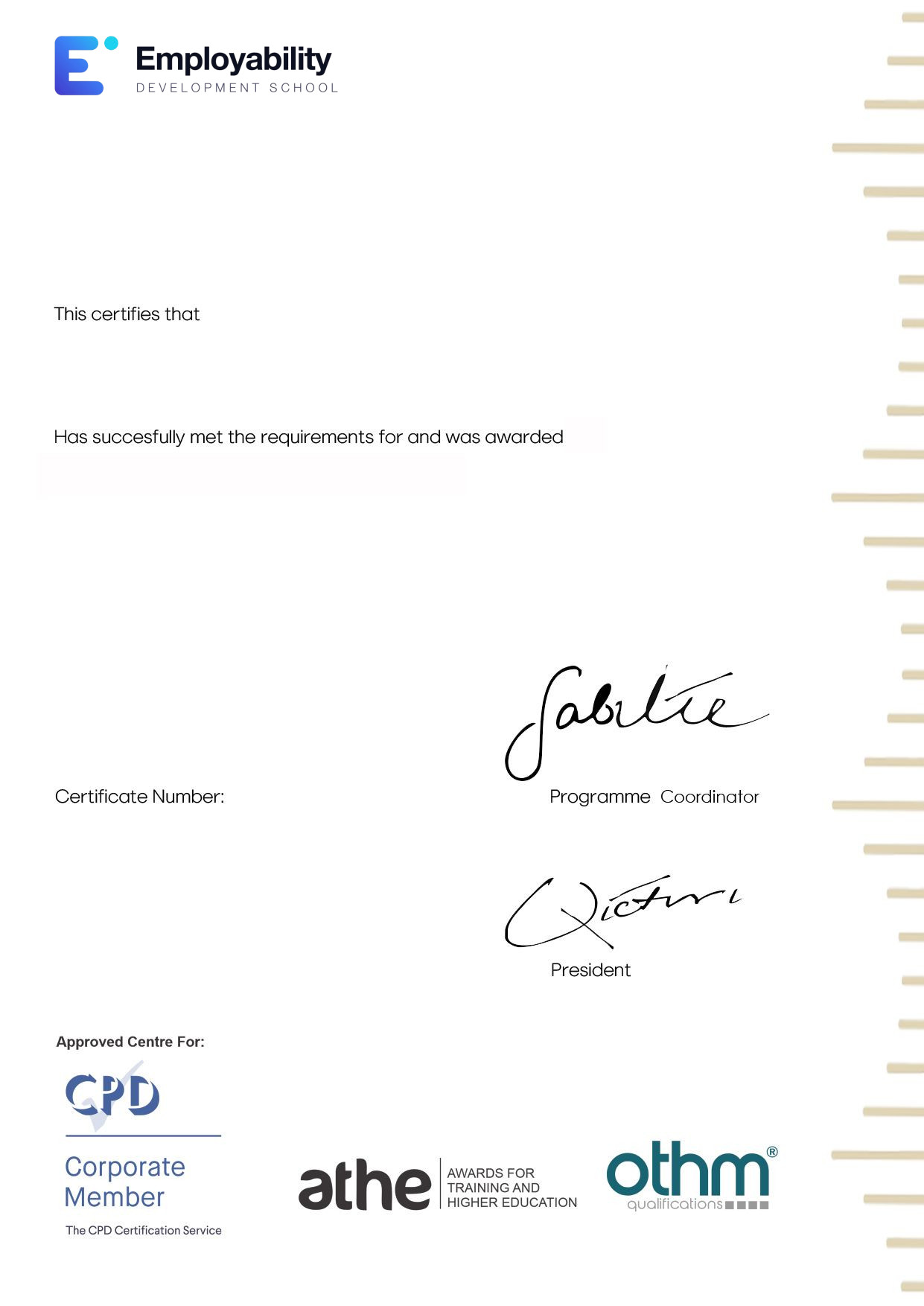
Sample Certificate
What you'll learn
Module 1
ASSIGNMENT & STUDY GUIDELINES
This module provides the most critical information about the study course and assignment submission.
Module 2
ADVANCED RESEARCH METHODS
This module is designed to provide students with a comprehensive understanding of qualitative and quantitative research principles essential for conducting doctoral-level research. It encompasses a thorough exploration of theoretical foundations influenced by research philosophy and approach, as well as practical insights into research strategies, data collection methods, and data analysis techniques. Moreover, students will gain the necessary skills to exercise ethical judgment throughout their PhD research endeavors.
Module 3
ADVANCED HUMAN RESOURCE MANAGEMENT
The focus of this module is on effectively managing individuals within a multifaceted organization. This entails tasks such as recruitment, selection, training, promotion, and motivation of personnel. It also involves enhancing personal commitment and overseeing staff to enhance their individual contributions, thus raising quality standards while simultaneously reducing operational costs.
Module 4
STRATEGIC MANAGEMENT AND BUSINESS ANALYSIS
The course introduces conceptual frameworks and models that will aid students in analyzing competitive scenarios and strategic challenges, fostering a deeper understanding of strategic management. This course offers a consolidation of prior course content within the business curriculum. Additionally, case studies complement the lectures.
Module 5
GLOBAL FINANCIAL MANAGEMENT
The objective of this course is to impart the principles of asset valuation and financing within the context of competitive global financial markets. This course is structured around three fundamental concepts in Finance: the temporal assessment of money, risk mitigation and diversification, and strategies like arbitrage and hedging. The temporal assessment of money serves as a foundational factor in determining the worth of various assets, including bonds, stocks, futures, and options. Our discussions on risk mitigation and diversification offer a comprehensive grounding in the trade-off between risk and return as expounded by modern portfolio theory. Regarding arbitrage and hedging, we illustrate methods for safeguarding against market risk, interest rate fluctuations, and foreign exchange fluctuations through the utilization of futures and options.
Module 6
ORGANIZATIONAL BEHAVIOUR
In this course, we will delve into the theoretical aspects surrounding individual and group behavior within organizational contexts. Student presentations and discussions will encompass comprehensive explorations of topics such as organization design, change dynamics, reorganization processes, and interactions between organizations.
Module 7
ADVANCED BUSINESS THEORIES
The objective of this course is to assist PhD candidates in gaining an understanding of the intellectual evolution of the business discipline. Throughout the course, students will explore the historical progression of this field, transitioning from an economic-centric approach to one rooted in behavioral aspects. Through the examination of various articles pertaining to each topic, students will not only acquire insights into the development of academic knowledge but will also be introduced to modern social science methodologies.
Module 8
ADVANCED MANAGEMENT
This module encapsulates the core of advanced research in the theory and application of business management. It encompasses various areas, including the analysis of contemporary management theories, the evolution of organizational structures, the dynamics of organizational behavior, and its connection to efficient administration. Furthermore, it delves into models pertaining to communication, motivation, and leadership.
Module 9
Segment 2 - RESEARCH/THESIS
This module imparts crucial insights into the study course and the process of submitting assignments.
How learners like you are achieving their goals
Participants in our courses don’t just learn new skills, they enjoy the experience too.

Zainab P.
EgyptExecutive Education
A smart way to enhance my knowledge within a short period of time, the course is very productive and beneficial for me...so grateful that i completed successfully...i would recommend my friends and family about the course.

Andrew S.
United StatesExecutive Education
Truly enjoyed the Strategic Management and Leadership Level 7 course and it provided me with a clear insight and helped me in my daily work as Plant Manager.

Richard T.
ScotlandExecutive Education
The modules were well structured, and gave me the knowledge to make sound decisions that maximize performance.

Rachel O.
NigeriaExecutive Education
I have learned a lot and gain experienced in this course. At first, I did not have confidence when standing front of audience but now, it is a different story.
Other related courses
DBA - PhD in Healthcare Management
The course offers learners a comprehensive understanding of various systems, principles, and mechanisms employed to safeguard and maintain the safety and hygiene of food.
-
Access to this course.
-
Access to library.
-
Learn at your own pace.
-
Tests to boost your learning.
-
Digital certificate when eligible.

Course starts
Anytime
Completion time
36 Months
Limited time offer
TTD 96,983
TTD 174,570
DBA - PhD in Marketing
The course is designed to acquaint learners with the principles, dimensions, and models of customer service. It offers valuable insights into developing effective strategies for enhancing customer service approaches.
-
Access to this course.
-
Access to library.
-
Learn at your own pace.
-
Tests to boost your learning.
-
Digital certificate when eligible.

Course starts
Anytime
Completion time
36 Months
Limited time offer
TTD 96,983
TTD 174,570
DBA - PhD in Finance
The objective of this course is to improve the learner's comprehension of employee engagement, including pertinent concepts and the challenges organizations encounter when implementing engagement policies, along with strategies for resolving these issues.
-
Access to this course.
-
Access to library.
-
Learn at your own pace.
-
Tests to boost your learning.
-
Digital certificate when eligible.

Course starts
Anytime
Completion time
36 Months
Limited time offer
TTD 96,983
TTD 174,570
Doctor of Philosophy (PhD) in Business Management
The PhD programme enhances and polishes your ability to research business challenges in today's environment and recommend viable solutions.
-
Access to this course.
-
Access to library.
-
Learn at your own pace.
-
Tests to boost your learning.
-
Digital certificate when eligible.

Course starts
Anytime
Completion time
36 Months
Limited time offer
TTD 96,983
TTD 174,570