Executive Master of Business Administration (EMBA) in Social Work
The programme is designed to offer skills and understanding in professional social work and in managing an effective community, family and individual social work.
Request follow-up
Fill in the form below and one of our student advisers will contact you soon.
Duration
12 Months
Pedagogy
Blended
Instalment
TRY 14,655 /month interest-free*
Total tuition
TRY 195,398
About the course
The Executive Master of Business Administration (EMBA) in Social Work is designed to fit around work and personal commitments. World-class teaching is delivered via pre-recorded online lectures to enrich the learning experience. We have perfected the art of delivering practical social work management education. Our practice-based approach focuses on addressing real-world business problems.
We don’t just give you the theory; we ensure you learn how to apply it in your working life immediately, with case studies, webinars, business simulations, and 100% project-based.
The Executive Master of Business Administration (EMBA) in Social Work allows you to achieve the qualification between 8 to 10 months, so it is a fast track to new opportunities and enhanced career prospects.
The purpose of this programme is to deliver to offer skills and understanding in professional social work and in managing an effective community, family and individual social work, which in turn is supported by appropriate reference to theoretical and conceptual analysis.
Course details
Assessment: Assignments
The objective of the Executive Master of Business Administration (EMBA) in Social Work qualification is to develop management and leadership skills for social workers who have the authority and personal attributes to translate social work into a viable social enhancement vehicle.
This qualification reflects current practice in Social Work and allows learners to develop and expand their high-level understanding of strategic challenges and leadership needs in Social Work.
Programme Structure and Credits:
This programme consists of 12 modules with a total of 120 ECTS credits.
Accreditation
All of our courses are accredited by the relevant partners and awarding bodies. Please refer to our information in about us for more details.
Entry requirement
For entry onto the Executive Master of Business Administration (EMBA) in Social Work qualification, learners must possess:
- An honours degree in a related subject or the UK level 6 diploma or equivalent overseas qualification, i.e. Bachelors Degree or Higher National Diploma
OR
- Mature learners (over 25) with at least five years of management experience if they do not possess the above qualification (this is reviewed on a case-by-case basis)
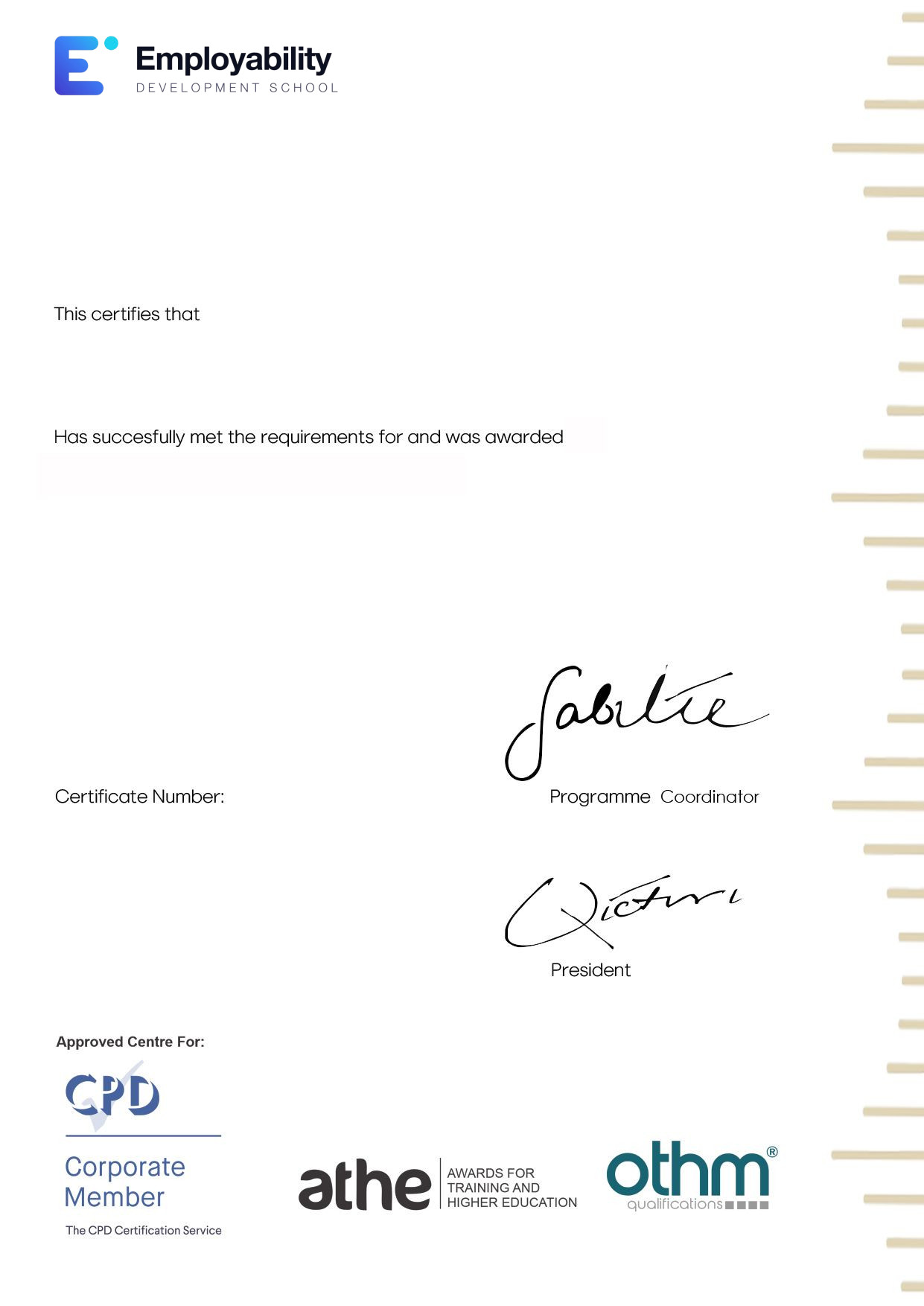
Sample Certificate
What you'll learn
Module 1
ASSIGNMENT & STUDY GUIDELINES
This module provides the most critical information about the study course and assignment submission.
Module 2
BUSINESS ECONOMICS
The course aims to analyze economic theory and its impact on business's interaction with society.
Module 3
BUSINESS MANAGEMENT
This module empowers students with the abilities to integrate sustainable development concepts into every facet of organizational operations. Emphasis is placed on cultivating a foundational understanding of sustainable development within supply chains. Students will develop the capacity to actively engage in discussions surrounding the challenges posed by sustainable development initiatives. Additionally, practical instruments essential for implementing sustainable development principles within supply chains will be furnished.
Module 4
STRATEGIC MANAGEMENT
This course instructs students in understanding the issues and difficulties faced by managers in strategic management. It acquaints students with concepts, methodological approaches, and tools relevant for assessing the strategic position of an organization. Throughout this course, students will acquire the knowledge of formulating and executing strategies and policies, along with recognizing their substantial operational consequences.
Module 5
HUMAN RESOURCE MANAGEMENT
Managing individuals within a multifaceted organization involves aspects such as human resource planning and development, assessing future requirements, structuring the personnel department to align with the evolving organization's needs, fostering career progression, creating training initiatives, and formulating policies. Furthermore, this course delves into subjects related to resource commitment, the efficient management of personnel to enhance individual contributions, enhance quality, and reduce operational expenses.
Module 6
MANAGEMENT INFORMATION SYSTEM
The course explores the dynamics and challenges of managing organization-wide systems for knowledge and information collection, organization and dissemination,
Module 7
OPERATIONS MANAGEMENT
This course delves into the domains of business related to production and operational functions. It encompasses the examination and enhancement of production and operations management (POM), addressing various POM challenges. Topics covered include productivity, encompassing planning and control, along with methods for its assessment. Additionally, we explore the intricacies of forecasting demand, utilizing both qualitative and quantitative techniques in various production scenarios. Inventory management is discussed, encompassing single and multiple period inventory systems, while statistical quality control methods are also introduced. Real-world management challenges are analyzed through case studies.
Module 8
LEADERSHIP AND ORGANIZATION BEHAVIOUR
This module explores the relationship between the leadership styles of the organization's management and the overall behaviour it impacts throughout the organization.
Module 9
SOCIO WORK IN COMMUNITIES, INDIVIDUALS AND FAMILIES
This module covers key elements that are essential for understanding the course material.
Module 10
PROFESSIONAL ETHICS
This module covers key elements that are essential for understanding the course material.
Module 11
QUALITY IMPROVEMENT IN HEALTHCARE ORGANIZATIONS
The module explores the role of continuous improvement in heath sector operations and management.
Module 12
GRADUATION PROJECT
Here, the learner will submit a self researched graduation project to apply the concepts learnt and skills acquired during the course
How learners like you are achieving their goals
Participants in our courses don’t just learn new skills, they enjoy the experience too.

Zainab P.
EgyptExecutive Education
A smart way to enhance my knowledge within a short period of time, the course is very productive and beneficial for me...so grateful that i completed successfully...i would recommend my friends and family about the course.

Andrew S.
United StatesExecutive Education
Truly enjoyed the Strategic Management and Leadership Level 7 course and it provided me with a clear insight and helped me in my daily work as Plant Manager.

Richard T.
ScotlandExecutive Education
The modules were well structured, and gave me the knowledge to make sound decisions that maximize performance.

Rachel O.
NigeriaExecutive Education
I have learned a lot and gain experienced in this course. At first, I did not have confidence when standing front of audience but now, it is a different story.
Other related courses
Executive Master of Business Administration (EMBA) in Renewable Energy and Sustainability
The course is designed to enhance your skills in understanding and managing renewable energy solutions and march your business towards sustainability as a business model.
-
Access to this course.
-
Access to library.
-
Learn at your own pace.
-
Tests to boost your learning.
-
Digital certificate when eligible.

Course starts
Anytime
Completion time
12 Months
Limited time offer
TRY 195,398
TRY 351,716
Master of Arts (MA) in Management
This comprehensive training seminar empowers participants to foster tourism and make informed management choices in the field of tourism and destination management.
-
Access to this course.
-
Access to library.
-
Learn at your own pace.
-
Tests to boost your learning.
-
Digital certificate when eligible.

Course starts
Anytime
Completion time
12 Months
Limited time offer
TRY 136,778
TRY 246,201
MSc in Project Management
The objective of the Professional Certificate in Monitoring and Controlling Projects is to provide learners with the necessary tools for effectively managing projects, ensuring they adhere to their defined scope and minimizing any potential deviations caused by project changes.
-
Access to this course.
-
Access to library.
-
Learn at your own pace.
-
Tests to boost your learning.
-
Digital certificate when eligible.

Course starts
Anytime
Completion time
12 Months
Limited time offer
TRY 234,477
TRY 422,059
MBA - Artificial Intelligence
The objective of the Advanced Professional Certificate in Strategic Leadership is to delineate the responsibilities undertaken by senior leadership in shaping an organization's future. This program aims to equip learners with the skills and knowledge necessary to become successful future leaders.
-
Access to this course.
-
Access to library.
-
Learn at your own pace.
-
Tests to boost your learning.
-
Digital certificate when eligible.

Course starts
Anytime
Completion time
18 Months
Limited time offer
TRY 230,569
TRY 415,024